Reading objectives and introduction
This is an English translation of the published reading. We will explore workflows, understand the role of APIs and MCPs in connecting tools and data, observe business scenarios, and evaluate security, cost, and long-term maintenance considerations.
Previously, we separately discussed Agents, retrieval, and RAG. However, in real-world scenarios, it may also be necessary to check inventory, read customer records, locate documents, and update systems. If these capabilities are isolated from one another, humans would have to constantly switch contexts, copy information, and coordinate manually. Orchestration attempts to connect these steps, enabling work around a single business outcome.
1. What is AI Orchestration?
Orchestrating involves coordinating multiple systems, tools, or Agents to achieve a goal. It may include four types of work: connecting to external services, sequencing actions, deciding which tool to assign a task to, and continuing or adjusting based on results.
The original material compares isolated tools to professionals in different fields and sequencing to a collaborative team. This analogy helps understand division of labor, but an actual system does not automatically learn, collaborate correctly, or add value simply because its components are connected.
From workflows to automation, knowledge retrieval, and system integration: this represents a teaching sequence, not a technical upgrade pathway that every organization must follow.
II. How does API enable systems to communicate with each other?
An Application Programming Interface (API) defines how software can make requests, exchange data, or trigger actions. It can be used between systems such as CRM and marketing platforms, payment and e-commerce, weather or financial data systems.
A customer service request can sequentially go through: request categorization, query relevant knowledge, assign a ticket, update customer records, and draft a response. Each step may be connected via an interface, but the risks associated with reading data and writing records differ.
An AI Agent can initiate interface calls, a chat application can query the database via interfaces, and a workflow platform can chain together multiple interfaces. Final execution still requires the application to handle authentication, permissions, parameters, errors, and return statuses.
III. The accurate meaning of MCP
The Model Context Protocol (MCP) provides a standardized connection between AI applications and external capabilities. The original text, in this section and in the accompanying video, repeatedly refers to it as "Model Communication Protocol" and describes it as a standard specifically responsible for communication between AI systems; this needs to be clearly corrected.
The host application management client in MCP connects to the server end; the server end can provide capabilities such as tools, resources, and prompts. Behind the server end, ordinary API access to databases, business systems, or other services may still be used.
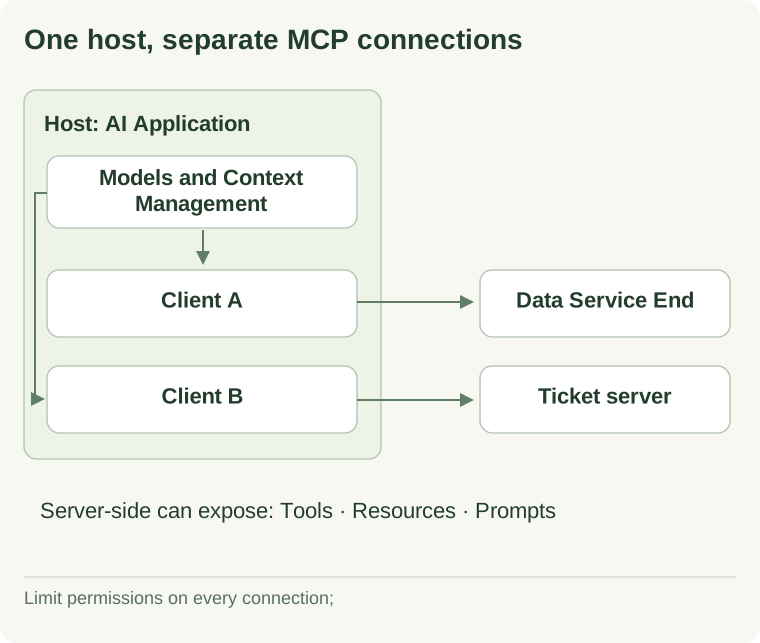
View textual explanation of the diagram
The host is the AI application, responsible for managing how the model is used and for multiple clients. In the diagram, client A connects to the data service endpoint, and client B connects to the ticketing service endpoint; service endpoints can expose tools, resources, or prompts. A unified connection method does not imply automatic assurance of access scope, facts, or execution security.
The figure shows boundaries for different connections. It helps reduce some redundant integrations, but the host must still decide which capabilities to use, provide what data, and enforce authorization and security rules.
"Original materials list capabilities and necessary distinctions"
Direction of the original material's discussion | Accurate understanding and boundaries |
|---|---|
Standardized communication | The protocol provides a common interface and message agreement, reducing the need for some custom adaptations. |
Discover and invoke tools | The application can discover capabilities exposed by the server, but cannot therefore access arbitrary tools. |
Context and Memory | Materials can be provided to the application; cross-session memory, storage, and data sharing are determined by the implementation. |
Resource optimization | Task allocation and computation optimization can be achieved by the upper-level system and are not automatically provided by MCP. |
Safety and Governance | The agreement involves the corresponding mechanisms, but organizational authority, trust, and approval cannot be substituted by names |
The original material further identifies four business values: First, share context and perspectives to enable diverse capabilities to jointly address complex issues; second, allow users to work through a unified entry point, reducing manual switching and cognitive load; third, leverage standardization to minimize point-to-point custom integrations and improve task allocation; fourth, facilitate easier integration of new capabilities when models or suppliers change.
Note: These are application design goals. The original text strongly emphasizes low cost, lossless background sharing, automatic resource allocation, and cross-vendor compatibility, but these should not be construed as protocol guarantees. Standardization can reduce some adaptation efforts, but also incurs operational, maintenance, security, and migration costs. MCP does not responsibility for automatically enabling multiple models to exchange all internal backgrounds or train each other.
IV. How do APIs and MCPs work together?
The original material characterizes API as a general software connection and MCP as a more suitable interface capability for AI usage. Below, we retain the comparative theme and distinguish the actual layers responsible.
Comparison theme | General API | MCP Connection |
|---|---|---|
Purpose | Access software features or documentation | Provide standardized capability discovery and usage methods for AI applications |
"Context" | Determined by interface and application design | Resources and cues can be provided, but long-term memory still requires application management |
Safety | Authentication, Authorization, and Service Rules | Still requires authentication authorization, trust assessment, and host control |
Resource allocation | Scheduled by application or platform | Does not automatically assume responsibility for resource allocation across the entire system |
Ability change | According to interface definition, version, and documentation | Can discover capabilities via agreement, but still need to adapt within supported scope |
Simple system integration, stable workflows, and connectivity to legacy systems may directly use APIs. To enable multiple AI clients to access tools and data through a standardized approach, MCP could be considered. For complex workflows, application orchestration, state management, monitoring, and error handling are typically still required.
The choice framework provided in the original material also includes the following items. To preserve the original intent, the following lists both the statements and the points requiring clarification.
Original text suggests route | The scenarios listed in the original text | Notes and Rationale for Translation |
|---|---|---|
Traditional API | Connect to database, CRM, and other business applications; unidirectional read/write; existing authentication is sufficient; process is stable; background sharing is limited; legacy systems already have interfaces | The API can also support complex bidirectional workflows; selection should be based on existing capabilities, permissions, performance, and maintenance conditions. |
MCP | Multiple AI sharing background, dynamic discovery capabilities, multi-step coordination; continuous session memory, sensitive data protection, cross-model learning; future addition of capability and resource allocation | Capability discovery is an important aspect of the protocol; long-term memory, cross-model learning, scheduling, and data policies require upper-layer implementations and cannot be considered as being provided by MCP simply because these features are needed. |
Hybrid route | API connects to business systems, MCP connects to AI capabilities, and then a gateway bridges the connection | Both can work together within the same call chain; the need for a gateway depends on the architecture and is not required for every project. |
"The binary distinction that 'APIs are for traditional systems, MCPs are for model-to-model communication' is inaccurate. Selection criteria should be based on actual connectivity, capability exposure, authorization, and workflow."
V. Business Scenarios
End-to-end customer experience
The original document describes an anonymous telecommunications company: customer service uses a chat system, billing is handled via automated phone calls, technical support operates through work orders, and sales manages customer interactions within a CRM system. When customers resolve issues across channels, they often have to repeatedly explain their issues and escalate them multiple times.
The original plan connects these customer-facing capabilities. After a customer contacts support, the system first retrieves the customer's history via an API, then uses RAG to search technical documents and existing resolutions, followed by checking the billing status. Based on the issue, it triggers the appropriate workflow and maintains appropriate context across different channels. This way, subsequent steps can leverage previously verified information without having to re-ask questions. The original text refers to its use of MCP; whether these capabilities are actually implemented remains determined by the overall application.
The case claims a 70% decrease in customer effort, a 45% improvement in first-time resolution, a 30% increase in satisfaction, and a 50% improvement in employee productivity. These figures lack verifiable sources and defined metrics, and therefore cannot be considered as general outcomes resulting from the agreement.
Strategic Research and Market Information
Another anonymous manufacturing company faces information scattered across industry reports, competitive analyses, customer feedback, internal sales data, and regulatory updates. Previously, this required manual collection and integration, with strategic planning cycles taking a monthly duration.
The original approach enables data collection capabilities to continuously monitor industry news and competitive shifts; RAG accesses internal performance and customer feedback; market analysis capabilities identifies patterns across these sources; planning capabilities drafts recommendations based on the comprehensive analysis; the workflow then distributes the findings to the relevant personnel. The output of each step becomes the input for the next, forming an interconnected process.
The original material claims that the planning cycle fell from four months to three weeks, market coverage increased by 40%, and forecasting accuracy improved, enabling management to make more timely decisions. This illustrates a proposed combination of workflow steps; the figures and attribution have not been independently verified.
Collection of data must still comply with access and usage terms and should not interpret "continuous monitoring" as arbitrarily harvesting private or restricted content.
Other duties
Scenario | What might happen after the connection is established? | Expected Value and Boundaries |
|---|---|---|
Customer service | Retrieve customer records, inventory, and product descriptions to prepare a response | Reduce switching; requires permissions and factual verification |
Finance | Obtain actual figures from the accounting system, then generate a summary | Provide traceable basis; still need to verify definitions and periods |
Marketing | Connect trends, ads, and experiment data | Support for comparison and adjustment; outbound and budget changes require clear authorization |
Human Resources and Training | Query policies, prepare onboarding documents, update records | Reduce repetitive tasks; personal data and write access controlled |
Operation | Combine ERP, weather, and logistics status to propose reminders or order recommendations | More timely response; order placement and other actions require execution boundaries |
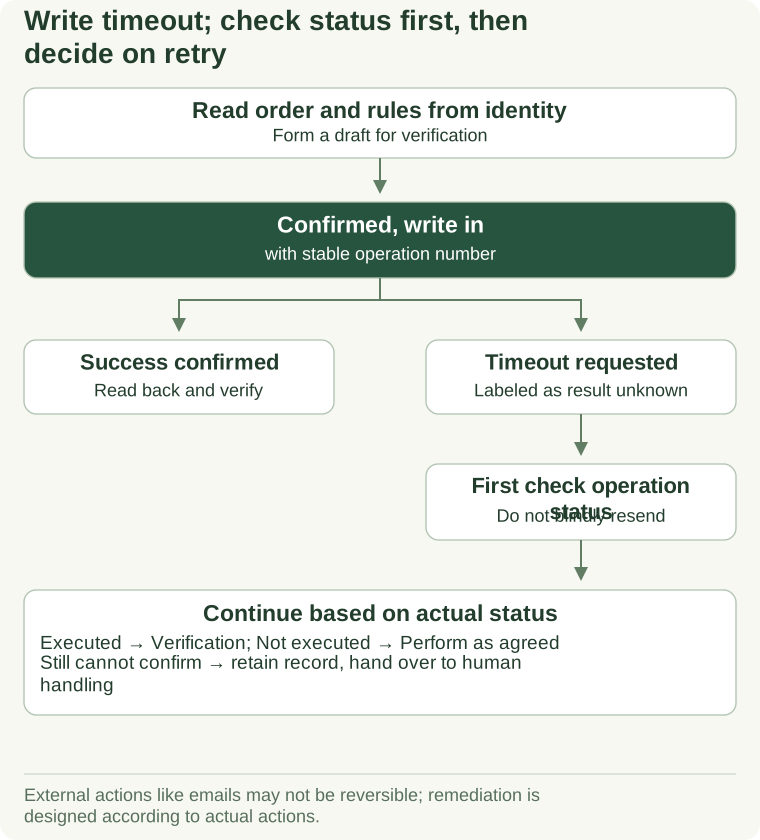
View textual explanation of the diagram
Read allowed orders and rules to generate a draft for verification, execute the write-in with a stable identifier upon confirmation. Normal acknowledgment proceeds to result validation; timeout results in unknown status, first check status by operation ID, validate if successful, if not executed then perform as per agreement, otherwise hand over to manual handling.
The diagram separates read and write operations. After a write timeout, it first checks the actual status to avoid mistakenly treating repeated requests as safe retries.
VI. Returns, Risks, and Readiness for Expansion
Combined capabilities may generate value exceeding that of individual tools, making information easier to reuse and enabling the formation of workflows tailored to specific business needs. However, "multiplied value," "automated acceleration of learning," and "mutual fault compensation" all require specific design and measurement and cannot be inferred solely from connectivity itself.
Need to manage four types of issues: security for interface and data access; vulnerability due to excessive connections; costs associated with each call, retry, and monitoring; and governance regarding which data and models are allowed to enter the same workflow.
Start with one or two clear integrations. Maintain modularity, establish responsibility rules that scale with complexity, and monitor the overall workflow completion rather than just individual models; when evaluating suppliers, also consider interfaces, open standards, migration, and maintenance conditions.
The next step connects to MoE. Need to distinguish: the sparse expert network within the model, from the business layer orchestrating multiple models or services, which are not the same architecture. MoE and AI Expansion Will continue to explain this difference.
Video script: Let isolated tools work together to complete a task
Previously, we introduced Agents, semantic knowledge systems, and RAG. However, in real-world organizations, these may be used separately: one for a customer service chatbot, another for automation, and a third for knowledge management and analysis. Each tool is useful on its own, but when used independently without integration, human operators still need to manually switch between them.
Imagine a customer inquiry that requires checking inventory, reviewing past interactions, reading product documentation, and updating the CRM. Without orchestration, a person must manually coordinate several systems; with orchestration, efforts are instead connected around a single, unified outcome.
API is a way for software to communicate. A request can first be classified by a model, then retrieved by RAG to find relevant information, followed by assignment processing and record updating, and finally prepared for response. Each step involves exchanging requests and responses through interfaces.
The original video refers to MCP as "Model Communication Protocol" and describes it as specifically used for AI models communicating with each other. Here, a clear correction is needed: the accurate name is Model Context Protocol, which standardizes how AI applications connect to tools, data, and services, not just for communication between AI models.
The original explanation uses the concepts of "shared language" and "plug-and-play adapters" to illustrate the convenience of discovery and usage capabilities, and also mentions context sharing, resource optimization, and security. It is important to distinguish that while protocols can help achieve interface consistency, memory management, scheduling, permissions, error handling, and governance still rely on the host and the system itself; a connection does not automatically confer all capabilities.
At the outset, it is recommended to start with one or two integrations. APIs can connect specific business services, while MCPs can provide common capability interfaces for AI applications, both of which often appear in the same call chain and do not need to be separated into two distinct, unrelated layers for traditional system-to-model communication.
Design should facilitate capability expansion while enabling end-to-end process monitoring, rather than focusing on individual tools. With systems capable of triggering actions across platforms, security, auditability, and accountability become even more critical.
The original video finally connects the extension to MoE. Inside the model, expert mixing and business-layer service scheduling operate differently and require separate understanding. A more useful conclusion is to have isolated tools collaborate within clear permission boundaries, and evaluate improvements based on actual outcomes, rather than treating the complexity of the ecosystem itself as success.
Related Reading
How do agreements align with actual implementation? See Tool Connection and Voucher Organization Demonstration ; Objectives planning and takeover see Business Agents .
Reference and Extended Reading
The following is the entry for editors to add supplements and verify translations.
- MCP Official Getting Started : English, query the exact purpose and capabilities of the protocol.
- MCP Architecture : English, distinguish host, client, and server.
- MDN: Overview of HTTP : Chinese, understand the basics of common interface requests and responses.
- n8n Documentation : English, view the actual workflow on how services are connected and how runs are processed.