Reading objectives and introduction
This is an English translation of the published reading. We will understand the differences between AI Agents and general automation, recognize how goals, plans, memory, and tools work together, examine personal, team, and organizational scenarios, and discuss supervision and trust boundaries.
Workflows first provide structure, automation handles execution, and AI can assist in interpreting inputs and generating outputs; Agents then further decide on the next step based on the goal. These represent different levels of assistance and do not imply that every system follows a fixed upgrade path.
1. Difference between Agent and Predefined Processes
Workflow describes how tasks and information flow. Rule-based automation executes clear conditions, while AI automation incorporates classification, prediction, or generation. Agents break down goals into steps, select tools based on existing results, and adjust actions accordingly.
For example, "save if email has an attachment" is a rule; "determine whether it's an invoice, hand it over to finance, and draft a summary" involves AI; "investigate competitors in this industry and complete a report" requires selecting materials, planning, analyzing, and reviewing multi-step outcomes.
The distinction can be understood as: fixed automation emphasizes executing tasks according to predefined methods, while an Agent emphasizes pursuing objectives within defined capabilities and permissions. It still relies on applications, tools, and rules and cannot assume that simply because it's called an "Agent" it can perform any action.
Two. How to Compare the Four Objects
Dimension | workflow | Rule-based automation | AI Automation | Agent |
|---|---|---|---|---|
"Core" | Steps, decisions, and handover structure | Condition triggers action | Model helps with step handling | Plan and adjust actions around objectives |
Flexibility | Depends on the design branch | Subject to existing rules | Can handle certain input variations | Can change route based on intermediate results |
Source of efficiency | Make the process consistent and traceable | Reduce repetitive operations | Add categorization and generation | Coordinate multi-step tasks and tools |
study | The structure itself does not learn | Rules are typically updated manually. | Pre-training capability does not automatically retrain | Feedback can be used to adjust the current strategy; further training design is pending. |
Integration | Can be handed over by personnel or system | API and Connectors | Use models in integration | Dynamically select different tools and sources |
Scope | Describe how the task is completed | Actions defined | Add capability in the definition process | Act within the scope of defined goals, permissions, and termination conditions. |
Examples | New Employee Onboarding Checklist | Save email attachment | Invoice Recognition and Assignment | Investigate, verify, and organize the report |
The original material describes the Agent's learning and efficiency as very strong, but "ability to adjust the next step" is not the same as "automatically updating model parameters"; greater autonomy does not guarantee higher efficiency or quality.
Real-time execution does not equal real-time learning
After receiving an email, the tool immediately invokes the pre-trained model, which falls under real-time execution. Whether the model is updated based on feedback depends on whether a data, training, evaluation, and deployment mechanism has been established.
The agent can remember tool results, rewrite plans, or choose an alternative approach within a single task, with context adaptation not necessarily requiring training. How long-term knowledge and experience are preserved also requires explicit storage and review.
Three: How do the core components work together?
Component | Functionality | The implementation directions listed in the original material | Impact on performance |
|---|---|---|---|
Planning | Break down goals into actionable steps | Search, constraint satisfaction or model planning | Impact on time and route for complex tasks |
"Memory" | Maintain history, context, and necessary records | database, vector, or graph structure | Impact on available background and persistence |
Reasoning and Decision-making | Determine the next step based on the information provided | language model or logic engine | Affect choice of quality |
Tool Interface | Connect to actual systems | API Packaging and Plugins | Determine actual executable capability |
Learning and Improvement | Update appropriate sections based on feedback | evaluation, rule adjustments, fine-tuning, etc. | Determine the method of improvement and maintenance costs |
Not every Agent needs all five modules independently, and reinforcement learning is not necessarily required. What matters is knowing which mechanisms actually exist.
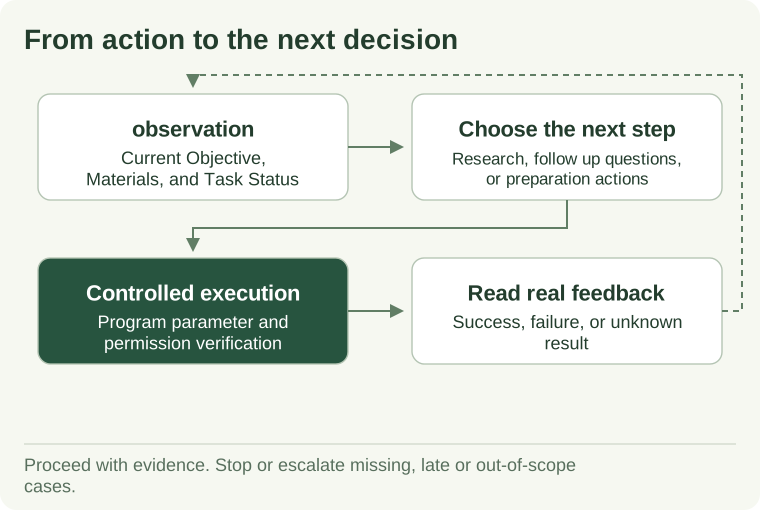
View textual explanation of the diagram
Current goal and environment observation, model selects tools and parameters, executes program after verifying permissions, then takes action; result returns as the next observation. Successful verification and termination, insufficient information or boundary reached, hand over to human operator.
The image highlights the actual state returned by the review tool. A plan is merely preparation; only the execution results determine whether to continue, change the method, or hand it over to someone else.
IV. Business Scenario Comparison
Scenario | Examples of AI automation | Examples of Agent | Expected Value and Checkpoints |
|---|---|---|---|
Customer service | Email Categorization and Assignment | Read the issue, draft a response, schedule follow-up, update records | Reduce task assignments; write-in and external dispatch require permissions and verification |
Marketing | Generate a title, schedule according to rules | Many channel solutions, test changes and recommend adjustments | May improve compatibility; budget changes cannot be executed without boundaries |
Invoice | Extract fields and upload | Verify anomalies, prepare for communication, recommend payment arrangement | Reduce data entry; payments and negotiations require clear authorization |
Recruitment | Conditional assistance filtering | Coordinate timing, communication, and organize candidate materials | The goal of improving processes must be measured objectively, not assumed to reduce bias. |
Study | Collect and save web pages | Compare sources, analyze, and produce reports based on evidence. | From sources to explanations; further verification of sources and citations required |
These are examples of task design, not results already achieved by the system. Adding more steps automatically could amplify errors, thus requiring more logging, permissions, and human intervention.
V. Pre-implementation inspection
Monitor key decisions, verify interoperability with existing systems, define which actions can be executed autonomously and which require confirmation, and provide mechanisms for correction and feedback. The broader the autonomous scope, the higher the governance requirements typically become.
Whether it is suitable depends on specific tasks, risks, and operational conditions, and it cannot be assumed that all organizations should adopt Agents simply because they represent a new direction.
Video script: From following rules to pursuing objectives
After understanding workflows, automation, and AI processes, we now turn to Agents: they don't just execute a single instruction; instead, they make decisions, choose actions, and adapt based on outcomes around a goal. Here, we shift from rule-based tools to more open digital collaboration.
First, clarify the layers. A workflow is a blueprint, describing how work occurs; an automation system executes it systematically; AI automation injects model capabilities into the steps; an Agent goes further by pursuing goals. A simple distinction is that preset automation follows predefined rules, while an Agent seeks a path to achieve the goal within defined boundaries.
Rules can be "save the email if it has an attachment"; AI steps can be "pass the invoice to finance"; for an Agent, something like "handle this customer issue" might be proposed, allowing it to decide what documents and actions are needed. Open-ended goals do not mean unbounded action; permissions and stop conditions must still be clearly defined.
Typical capabilities include: accepting goals rather than just step-by-step instructions, breaking down complex tasks into actionable steps, selecting tools and methods based on context, retaining essential contextual information, and adapting strategies based on which methods prove effective.
It can be analogized as assigning a task to a collaborator capable of choosing approaches, but this is a functional analogy and does not imply it possesses human understanding or responsibility.
There might be a planning engine that breaks down steps, a memory system that stores historical data, model or logic modules that make judgments, tool interfaces connecting to external systems, and a mechanism for improvement based on feedback. Together, these support adaptability rather than always following the exact same path. Whether long-term model training is conducted depends on the actual design and should not be conflated with adjusting plans within the current task.
Implementations must be checked and supervised: How are major decisions monitored? Integration check: Can it work with existing systems? Trust boundary check: What actions are allowed autonomously, and what are not? Re-establish feedback mechanisms to detect and correct errors.
An expanded autonomy range also implies a greater need for governance. Agents will shift their focus from individual actions to goal completion (whether to adopt them and how to deploy them) based on task and risk assessment, rather than simply because they are labeled as next-generation technology.
Related Reading
Put goals, permissions, and manual takeover back Trustworthy AI Framework Inspection; the complete execution process of the voucher project is as follows Tool Connection and Invoice Agent .
Reference and Extended Reading
The following is an editorial addition.
- Anthropic: Building effective agents : English, compare the structure and trade-offs of preset workflows versus Agent systems.
- MCP Official Getting Started : English, query how an Agent application can connect to capabilities via standard interfaces.
- NIST AI Risk Management Framework : English, assistance with evaluations, permissions, and responsibilities.