Reading objectives and introduction
This page provides a English translation. We will understand how RAG combines retrieval and generation, compare the different purposes of directly searching for information versus organizing responses based on retrieved information, examine real-world use cases, and explore considerations around quality, permissions, and maintenance requirements.
The organization has years of experience in reporting, customer insights, project management, and professional documentation, but general models do not automatically know these contextual backgrounds. Simply relying on generic responses is often insufficient when asking, "What lessons from the product launch last quarter can be applied to the next activity?"
Semantic retrieval Help locate relevant materials; RAG further brings the selected references into the answering process. This isn't about having the model permanently learn all business knowledge, but rather providing appropriate content when needed.
1. What is RAG?
Retrieval-Augmented Generation (RAG) is an application design pattern: first retrieve relevant materials based on a query, then have a generative model combine these contents with its linguistic capabilities to formulate a response.
Can be analogous to a document administrator: retrieval involves locating relevant books, while generation involves organizing and summarizing the content obtained. This analogy does not guarantee that the administrator always finds or reads the materials correctly, so the results still require verification and cross-checking with the original sources.
RAG does not replace training and is not necessarily real-time. The system can only access new information when the data and index have been updated.
II. Return the materials directly, without generating explanations
Dimension | "Only retrieve" | Generate after retrieval |
|---|---|---|
Behavior | Return relevant documents or records | Organize natural language responses based on the found evidence |
Examples | Show the supplier X's three most recent contracts | Summarize the main risks of these three contracts |
Value | Get raw materials more quickly | Reduce some reading and integration tasks |
Restriction | People still need to read the explanation | Retrieval and generation at any stage may go wrong |
Purpose | Audit, verification, obtain original documents | Supportive analysis, briefing, and communication |
Note: The original material refers to both as "two modes of RAG." Strictly speaking, returning only the retrieved materials belongs to retrieval and has not yet involved generation. Both can coexist in the same product, but they must be clearly distinguished.
Three: How does the complete process work?
Step one: understand the query. In vector retrieval schemes, convert the query into an embedded representation compatible with the index; this can also be combined with keyword, field filtering, or other retrieval methods.
Step 2: Find knowledge. Search for candidate snippets based on semantics, keywords, time, permissions, and other conditions, and determine whether they genuinely support the current question.
Step 3: Provide contextual organization. Present the question, relevant original text, source, and necessary conditions to the generative model, avoiding the inclusion of excessive irrelevant content.
Step 4: Generate and verify. The model organizes the answer, and the application provides traceable sources. Check important facts, numbers and conditions further. If evidence is insufficient, acknowledge the gap rather than inventing information.
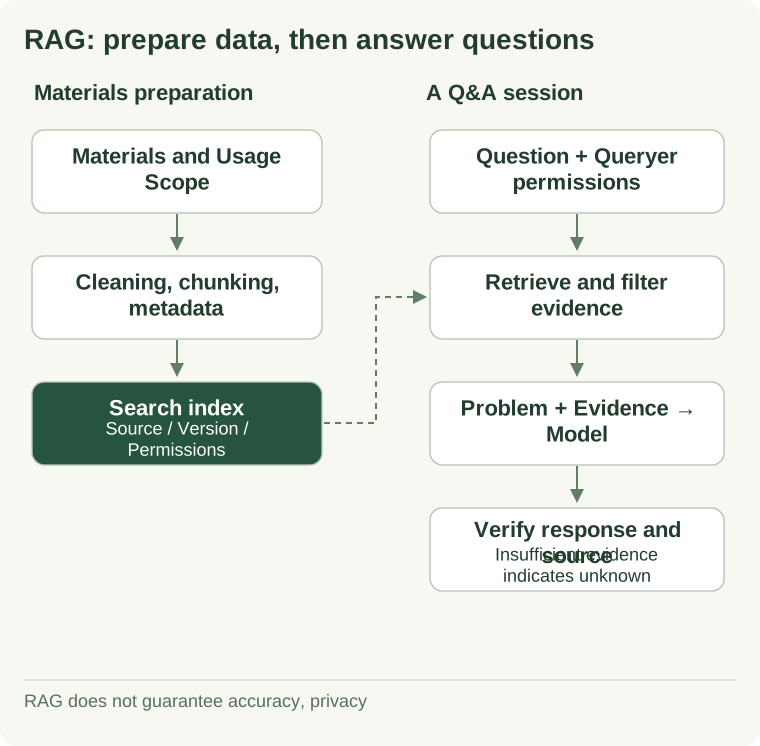
View textual explanation of the diagram
Data preparation paths include chunking, preserving version-level permission metadata, and indexing. The question-answering path starts with the query and user permissions, retrieves available chunks, passes them to the model for structured response, and then verifies factual accuracy and citation. Missing evidence, selecting the wrong version, or generation distortion represent distinct issues.
First, establish a data index in the diagram, then select the basis when posing questions. Updating data, synchronizing permissions, handling deletions, and checking references all fall under system maintenance.
Four: How Does It Respond to the Model's Limitations?
Model training is limited by time and data scope, and may generate content that sounds plausible but is incorrect. RAG can provide organizational knowledge or more recent information, allowing responses to be based on checkable sources.
It may improve trust and efficiency, but cannot guarantee the elimination of hallucinations. Outdated, missed, or misidentified information, or misinterpretation during generation, can all lead to errors; additionally, citing sources does not necessarily mean they actually support the conclusions.
V. Business Scenarios and Potential Value
Organizational knowledge management
The original material cites an anonymous consulting firm with 15,000 employees. Previous plans, reports, and methods were scattered across different locations, and personnel might have repeatedly solved problems that had already been addressed. RAG indexes relevant experiences so that one can ask: "What experiences exist for digital improvement in manufacturing enterprises ranging from 500 to 1,000 employees?" and receive a curated, source-annotated response.
The original case claimed a 40% reduction in preparation time and a 25% increase in proposal success rate. No research sources, sample sizes, or measurement conditions were provided, making it unsuitable as a commitment for any organization. The case aids in understanding how to link relevant materials to outcomes, rather than offering replicable performance results.
Customer Support
When there are many documents, forums, and past tickets, service personnel might spend a long time searching. RAG can index product documentation, known issues, and resolution steps, and return relevant steps after receiving a description of the customer's issue.
The original text provides anonymous data showing a 60% reduction in average resolution time, a 35% improvement in first-time resolution, and a 50% faster onboarding for new users; another overall table cites a 40% processing speedup. These cannot be considered a single, unified metric, nor represent a general effect.
Other duties
Function | The original difficulty | How can retrieval and generation help? | Need to verify |
|---|---|---|---|
Legal and Compliance | Find exact clauses and cases | Identify and draft a suitability summary | Jurisdiction, Edition, and Professional Judgment |
Sales and Customer Readiness | Search historical interactions and reports | Compile a trackable client briefing | Confidentiality scope and factual accuracy |
Research and Innovation | Dispersed materials, different terminology | Connect related literature and provide supplementary explanation | Source Quality and Over-Interpretation |
Human Resources and Training | The manual is complicated and policies are hard to locate | Find the relevant sections and explain them in simple language | Applicable Objects, Regions, and Latest Policies |
The business value proposed in the original table includes: faster legal review with reduced omissions; saved time and improved responsiveness for clients; easier cross-team sharing during research, leading to faster insights; and easier policy understanding for employees, reducing repetitive answers from human teams. The 40% speed improvement cited by customer service is retained as stated above. All these are target outcomes that remain to be validated and cannot be guaranteed by adopting RAG.
These processes are designed to make human knowledge more accessible and usable, rather than having generative systems take over all professional judgment.
VI. Restrictions and Implementation Conditions
Data quality determines the reliability of information: outdated, incorrect, or poorly organized content can affect retrieval. Each additional step may also increase costs and delays.
Sensitive information must first have clear access permissions and handling procedures; it cannot be assumed that all employees can read it simply because it's part of an "internal knowledge base." Providing sources helps verify information, but sources must also be accessible, specific, and directly support the conclusions drawn.
RAG can serve as part of a composite system that connects tools with specialized models; it does not imply a necessity to gradually evolve into a specific advanced architecture. The original text refers to MCP as "model communication protocol" and conflates it with a multi-Agent framework; the accurate name is Model Context Protocol, which is not a general-purpose multi-Agent orchestration framework.
Seven. Directions for Further Development
Multimodal RAG attempts to connect text, images, audio, and video; real-time data integration attempts to incorporate market, status, or business metrics; collaborative knowledge bases allow teams and experts to jointly maintain content and annotations.
All of these directions require specific implementation. The team compiled the materials, which does not mean the model automatically learns; the data source is real-time, which does not mean the final answer has been verified against the latest version.
Before you begin, take stock of your knowledge assets to identify which documents are trapped in silos; establish shared, permission, and quality guidelines; assist teams in adapting to new query methods; and plan integration with existing systems and workflows.
Video script: Bring organizational knowledge into the current task
Organizations may have accumulated years of reports, customer insights, project experience, and professional documentation. Yet when work requires specific information, people resort to generic tools that lack understanding of this background. RAG attempts to bring the relevant materials into the responses, enabling the system to go beyond general explanations.
General models are limited by the training data and time range, and may generate seemingly credible but incorrect content without reliable basis. If asked "What experiences were there from the product launch in the previous quarter?", the model cannot know internal experiences merely by imagination.
RAG, or Retrieval-Augmented Generation, first retrieves relevant materials, then combines the retrieved content with the query before generating a targeted response. It does not retrain the entire model on all the materials, but instead provides evidence when needed.
Can be analogized to a document archivist: first locate the appropriate book, then organize the response based on its contents. This adds an extra step of explanation compared to simply finding the file, but retrieval or comprehension may still go wrong, hence the need to verify the source.
The original explanation compares two usage methods. "Display the contract of supplier X" can directly return the original document; "summarize the main risks of these contracts" requires reading and generating content. Strictly speaking, the former involves only retrieval, while the latter includes the generative component of RAG.
Return the original material directly for tasks requiring reference to the source text; generate summaries to assist in analysis and communication, but this does not automatically guarantee suitability for compliance or important decision-making. Both should verify the scope of materials, with the summary additionally requiring verification that it accurately reflects the original content.
When preparing, first inventory organizational knowledge to identify valuable data trapped in silos; establish shared, access, and quality guidelines; plan how to connect existing systems. The effectiveness of the system depends on the actual data provided and maintained.
RAG can also be combined with Agents, APIs, and other capabilities to become part of a complete workflow. It does not replace human knowledge but makes it easier to locate and apply to current tasks; its effectiveness must be evaluated through actual queries, responses, and usage of results.
Related Reading
Read first Vector databases and semantic search Understand retrieval; if the system needs to perform actions, then proceed. MCP and API the connection and permissions.
Reference and Extended Reading
The following is an editorial addition.
- AWS: What is RAG? : English, the basic combination of query, retrieval, and generation.
- Microsoft: RAG Overview : Chinese, understand retrieval, information preparation, and application conditions.
- RAG Original Research : English, review the research background of retrieval-augmented generation, and distinguish original research from the various products implemented today.