Reading objectives and introduction
This page provides a English translation. We discuss performance, cost, specialization, and governance when AI scales up, and understand the concept of "Mixture of Experts" (MoE).
The original material combines two distinct layers: the expert network within the model, and the business routing that assigns requests to different specialized services. Below we retain the original business logic explanation while clearly distinguishing between the two, to avoid treating them as the same architecture.
1. From Connection Tools to Scale Management
As usage grows, organizations face more tasks, costs, and system complexity. The original explanation uses a corporate division analogy: in early stages, a single leader might oversee sales, strategy, and operations; later, these responsibilities are taken on by specialized roles.
This analogy suggests that we don't need a costly, general-purpose service to handle all tasks. However, specialization does not necessarily mean better, and it does not imply that every system must eventually transition to MoE.
The previous content offers several combinable capabilities: workflow definition to define processes, automated execution of steps, agent actions oriented toward objectives, retrieval and RAG for information sourcing, and tool integration and orchestration. The selection of which combinations to use should be determined by the business problem.
Two: What exactly is MoE inside the model?
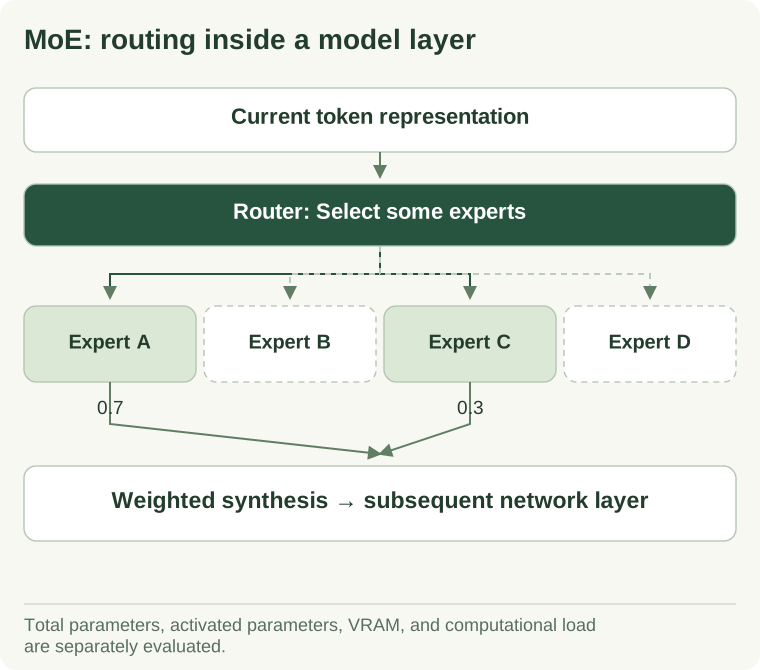
In common sparse MoE language models, certain layers contain multiple expert subnetworks. The router selects a subset of experts to participate in computation based on the representation of the current token, then combines the results.
View textual explanation of the diagram
The current token representation enters the router, which selects experts A and C from four illustrative experts. Their outputs are combined with weights of 0.7 and 0.3. Unselected experts do not perform that computation in this step; shared modules may still participate. Other tokens and layers may follow different routes. These experts are not professional assistants.
In the diagram, selecting two experts from four is a hypothetical aid for understanding. It does not mean first treating the entire user request as a "financial issue" and then passing it to an independent chatbot named a financial expert. Different tokens or layers might select different experts, and the actual implementation could follow various pathways.
Sparse activation can limit the amount of computation per token by restricting activated parameters, even when the total number of parameters increases; however, it may still require substantial memory, communication, and runtime resources. The total number of parameters and the number of activated parameters must be distinguished, and one cannot simply conclude that hosting costs will be lower merely because of reduced activation computations.
Note: This section supplements to correct the confusion in the original material regarding concept usage. MoE experts are typically subnetworks formed through internal learning within the model, and do not necessarily correspond to specific human professions such as finance, marketing, or legal affairs. The multi-model routing at the business layer is an application architecture approach that can use MoE models or choose not to use them at all.
III. Professionalization Approach of the Original Materials
The original explanation refers to "the MoE" as "the Mixture of Experts" where the gating system distributes requests to appropriate specialized models. Under a business-layer routing perspective, tasks can be compared based on difficulty, expertise requirements, cost, and latency, allowing different services to handle different portions.
Simple tasks can be handled with lighter implementations, while complex tasks require more appropriate models; however, routing decisions, misclassification, fallbacks, and consistency all incur additional costs. Specialized models may only outperform general-purpose models when they are well-suited to the data and task and have been evaluated accordingly.
The original statement claims a certain anonymous professional services firm reduced costs by 60% and improved response quality by 35%, without providing sources or definitions of quality, and thus cannot be considered generalizable benefits of the architecture.
IV. How are business scenarios divided?
Multi-domain customer support
The original case involved a tech company that initially used a single model to answer all questions. It followed the same path (from simple product inquiries to complex troubleshooting) leading to two issues: technical questions were addressed insufficiently in depth, while simple questions were explained unnecessarily in detail. User experience suffered, and the rate of escalation to human support was also high.
It later categorized its support capabilities into four types. The first type handles common issues, accounts, and general inquiries; technical support manages product troubleshooting, integration, and developer assistance; billing support handles subscriptions, payments, and account changes; sales support handles features, pricing, and upgrade options. The system selects the appropriate capability based on the issue and transfers the case to human agents when necessary.
This division of labor helps control the scope of knowledge and tools, but does not necessarily imply an MoE within the model. Issues might span multiple categories and require handling of handoffs and responsibilities.
The original text provides anonymous figures indicating a 55% improvement in resolution, a 40% increase in satisfaction, a 30% reduction in cost, and a decline in manual escalations from 45% to 15%. Without original sources, reducing escalation rates alone cannot be considered a sign of quality improvement; incorrectly blocking manual intervention may also be harmful.
Content and Marketing
The original material describes a marketing agency using the same generic model to produce all content, resulting in inconsistent quality across different content formats and client industries: blogs resemble social media snippets, technical documentation resembles marketing copy, and industry content lacks subject-matter expertise.
It recommends establishing specialized skills across different domains. Technical writing focuses on documentation, white papers, and technical materials; marketing copy emphasizes persuasion, calls to action, and brand tone; industry expertise addresses sectors such as healthcare, finance, and technology; social media skills cater to platform formats and engagement requirements. Different deliverables are evaluated using distinct criteria, all while collectively upholding customer and brand consistency.
The case claims a 50% increase in speed, a 65% improvement in customer satisfaction, and better pricing and retention. These are unverified teaching assertions. Actual implementation should compare content quality, rework, and review, rather than focusing solely on output volume.
Other duties
Function | General model practices in the original material | "Original material envisages professionalization" | Expected business value of the original materials |
|---|---|---|---|
Legal Affairs | A general model analyzing a contract might miss subtle nuances | Contract-related issues to be handed over to the corresponding specialized model | Assist legal reviews faster and more accurately |
Customer service | A large chat system handles all inquiries | Select capabilities by bill, technical, policy, and other categories | Improve accuracy, reduce unnecessary upgrades |
Marketing | The same model generates general content | Distinguish social media, SEO, and customer analysis capabilities | More targeted activities and better return on investment |
Finance | A model attempts to summarize all financial data | Reporting and risk, compliance use appropriate capabilities respectively | More reliable analysis, fewer errors |
Human Resources and Training | A model answers all employee questions | Onboarding, policies, and learning recommendations handled separately | "More aligned with individual contexts" |
These statements pertain to business capability assignments and expectations, not verified outcomes. Legal work still requires professional review, financial data still needs verification, and employee support involves privacy and fairness considerations; one cannot therefore conclude that a specialist in a sparse model has the requisite qualifications.
V. Potential Gains and Actual Constraints
The original material discusses the strategic benefits of this business division from four aspects.
First is cross-domain capability. If different domains have specialized abilities suited to their respective tasks and can collaborate effectively, an organization can enhance performance across multiple business areas without requiring equal strength in all domains. Second is cost control after scale expansion: allocate computing resources based on actual task requirements, avoiding the need to always invest in resources sufficient for the most complex problems.
Third is adapting to new domains. When new business requirements arise, the application layer can consider adding appropriate services, rather than rebuilding the entire infrastructure or retraining general-purpose models from scratch. Fourth is risk dispersion: if a particular capability fails or requires maintenance, well-designed alternative components may still continue to operate.
These are architectural objectives that require investigation, not automatically achieved outcomes. Shared infrastructure, routers, or data services may also become common points of failure; new capabilities still require integration and evaluation.
Constraints to address include: governance of additional models and suppliers; consistency in output style and factual accuracy; interface and orchestration integration; new licensing, hosting, and maintenance costs; and alignment with the organization's actual needs.
Internal experts in a model typically cannot be added or removed as freely as ordinary plugins; adding a specialized service to a business system does not equate to completing MoE training. The two types of extensions have different costs and evaluation methods.
Six. Future Vision
The original document envisages three possible future directions.
One type is an autonomous expert network: the system identifies the need for new capabilities, develops or acquires the corresponding capabilities, and integrates them into the existing network, enabling the organization to manage a continuously evolving ecosystem. The second type is cross-organizational sharing: industry consortia and professional services markets allow organizations to leverage capabilities developed by other entities, forming specialized networks that individual organizations cannot build alone. The third type is rapid capability formation: in response to new business models, regulations, or market changes, the system adapts to new tasks within a shorter timeframe.
These are the original materials' visions for the future, not verified features currently available on this page, and do not indicate that the system can obtain new permissions without human approval.
Automatically acquiring new capabilities still involves data licensing, assessment, authorization, and accountability, and it cannot be assumed that "a few days to become an expert" is sufficient to handle new regulations or high-consequence tasks.
It also presents a temporal outlook: in the near term, greater adoption of RAG and API; in the mid-term, enhanced standardization of connections; in the long term, more complex expert and multi-Agent ecosystems. This is not an inevitable path; technological adoption should be adjusted based on actual outcomes.
Seven: How to Prepare for Change
Basic principles include the following four items:
- modular : A new capability can be integrated without having to completely rebuild the entire system.
- Interoperability : Existing investments can be integrated with other applications and future technologies.
- governance : As technological complexity increases, policies, responsibilities, and procedures can also expand accordingly.
- Human-machine collaboration : Roles and processes simultaneously leverage human experience and system capabilities.
Corresponding investments are not limited to the model. Infrastructure includes API management, monitoring, and integration platforms; skills development enables teams to collaborate with more complex systems; data quality provides suitable input for various tasks; change management helps organizations continuously adjust processes and responsibilities.
A more mature organization should enable AI to align clearly with business objectives, continuously measure resources and outcomes, integrate new capabilities, and gracefully pause or discontinue usage when appropriate. Feedback and knowledge updates must be supported by actual processes, not merely claimed system self-improvement.
The next step that can be taken
Immediate actions include assessing the organization's current position, selecting the most valuable next step based on existing capabilities and business needs, and establishing governance that can scale with increasing system complexity, as well as organizational capabilities for collaborating with AI.
Strategic planning should consider the complete development pathway, not just address current needs. Invest in foundational capabilities such as data quality, API management, and skills that support multiple roadmaps; establish success metrics aligned with business outcomes; and build the ability for continuous change, not just evaluate a single model's test score.
Continuously monitor trends, develop cooperative relationships with accessible professional support, maintain experimental and learning spaces, and establish ethical boundaries for enhanced capabilities. The original material emphasizes incremental implementation, human-machine collaboration, and adaptability to change; these are more valuable in the long term than pursuing a specific architectural name.
Video script: Professionalism and Expansion
Workflows, automation, Agent, information retrieval, RAG, and orchestration open up numerous possibilities, but as systems scale, new challenges arise: how to expand capabilities without losing control over costs and complexity?
The original explanation uses the analogy of organizing work by function. Having a general, large-scale service handle all tasks, like having a manager personally respond to every customer email, might not be cost-effective. As the organization grows, it will develop roles such as finance, marketing, and technology, each responsible for their respective expertise, and then coordinate when needed.
It calls this form of specialized division MoE: preparing different specialized capabilities, with a gatekeeper or router selecting the appropriate one. Simple issues are handed to lighter services, complex technical problems to the appropriate tools, and financial analysis to the suitable capability. The goal is better quality, investment, and scalability.
But this is an analogy for the business-layer routing. A common sparse MoE model activates a subset of expert networks based on token representations within internal layers, which does not equate to handing over an entire request to a separate financial or technical chatbot. The main text has separately explained both levels.
Connect the previous concepts: workflow defines structure, automation reduces repetition, Agent selects actions, knowledge system provides context, RAG brings knowledge into responses, orchestration links tools. They can work together, but every organization doesn't need to adopt every step of this pathway.
The original video concludes with future opportunities. In practice, one should start from current goals and conditions, measure outcomes, and build maintainable capabilities; future visions cannot be directly treated as functionalities already realized today.
Related Reading
If you want to compare the collaboration of multiple Agents, first look at Business Agents ; If different tools are to be integrated into the workflow, then proceed to examine MCP and API .
Reference and Extended Reading
The following are editorial supplements and translation notes; anonymous business revenue figures are not supported.
- Hugging Face: Mixture of Experts Explained : English, query sparse layers, routing, activation parameters, and trade-offs in deployment.
- Google: Expert Choice Routing : English, research on routing mechanisms between tokens and experts.
- Hugging Face: Expert Computing Interface : English, query model internal expert computation and backend implementation.