Reading objectives and introduction
This page provides a English translation discussing modern AI data pipelines, tool selection, and long-term design. The data pipeline determines what is collected, how it is cleaned and organized, how it is updated, and what information is available to the model when generating responses.
First, review the evolution of data systems from transaction processing to retrieval, machine learning, and generative applications, then understand the practical aspects of building and maintaining them. A good system does not start with just a model; it also relies on data and the people who manage that data.
1. How has the data system evolved?
From storing and retrieving records, to searching, and then supporting reasoning and generation, each stage transforms the purpose of the data pipeline. Understanding this path helps determine where your system currently stands and what's still missing.
The historical videos here and "Data Foundations and Privacy in the Context of 'Data System Evolution' Script" It's the same document; the full translation is saved here, and will not be copied elsewhere. Below, different pipeline, tools, and design explanations are retained on this page.
II. Building Modern Data Pipelines
From collection and cleaning to structuring and orchestration, the goal is to establish a clean, flexible, and reliable data flow. Don't spend a long time building complex infrastructure only to discover it doesn't align with the applications.
Modern language and embedded tools can help process unstructured text, but they cannot automatically correct errors in facts, permissions, or sources. Regardless of whether using cloud services or building in-house, validation should begin with small, concrete objectives.
Three: Selecting tools for the project
RAG, fine-tuning, vector databases, and function calling address different problems. Middleware, orchestration, caching, fault rollback, and observability also impact the overall experience.
The selection should not only consider whether the first version works, but also speed, accuracy, flexibility, and whether the team can sustainably maintain it.
IV. Long-term Design Strategy
How often should the pipeline run? How can we manage processing costs and complexity? What if tools change, interfaces fail, or source data disappears? These scenarios all require prior planning.
There's a trade-off among performance, reliability, cost, and risk. The goal is to have the system available today and capable of being updated as requirements and environments evolve, rather than being locked in by early design choices.
Video script one: The actual operation of the pipeline
Behind every AI system lies a practical task: building a data pipeline. It connects different components, determines what to collect, how to clean the data, and how the model should use it.
In traditional content projects, teams must extract content from multiple systems, clean and reconcile inconsistencies, then convert it into usable formats. If the original systems cannot communicate with each other, the process can take weeks, months, or even longer. The original explanation referenced an early large-scale project in which dozens of people spent years extracting data from paper files, illustrating that this work previously required substantial manual effort.
Modern language, embedding, and indexing tools can reduce the need for manual summarization or metadata creation. Unstructured content can also be quickly transformed into searchable representations, uncovering relationships that would be difficult to identify through manual, item-by-item annotation. However, not all data can be processed in minutes, and the establishment of vectors does not guarantee accurate understanding.
Cleaning is not just about fixing fields
Previously, cleaning referred to fixing issues such as missing identifiers or date format errors. The language system also needs to remove noise that could cause confusion.
For example, feeding a long sequence of email inquiries into the model, which may include email headers, signatures, disclaimers, and irrelevant replies, can occupy context and cause the model to misinterpret tone, focus on the wrong sections, or produce confusing responses.
Therefore, cleaning is more akin to judicious curation: deciding what must be retained and what can safely be omitted. When making such decisions, avoid removing sources, conditions, and key limitations simply to make the content shorter.
When do you need structure?
Must all materials be fully converted into tables before use? Sometimes yes, sometimes no. Traditional tasks often require consistent formatting and clear labeling; language applications can also handle semi-structured or even free-text inputs.
But structure still matters. It helps control scope, allowing the model to read narrative content while accurately retrieving specific fields via API or SQL. Formats like JSON and YAML can organize information. Unstructured text and structured queries can work together without having to completely exclude one in favor of the other.
Move, update, and monitor
After selecting the data sources, you need to plan how to move the data, how frequently to refresh it, and how to monitor it. This intersects data engineering with operations and maintenance. The original list includes Airflow and Prefect for scheduling, dbt for transformation, Kafka for ingestion, and cloud services such as AWS Glue and Azure Data Factory.
Choose based on team capability, data sources, time, and budget. Avoid overbuilding; if a reliable execution once per night is sufficient, there's no need to start with a complex real-time architecture. But it must be repeatable, observable, and testable.
A common failure is spending months building a pipeline only to discover it doesn't meet the actual needs. Start with a small, clear goal using partial data, quickly validate assumptions, and then gradually scale up.
Human feedback also needs to be incorporated into the process. A consulting robot might be generally accurate in its facts but inappropriate in tone; a scheduling tool might present seemingly reasonable options that are actually unexecutable. The issue is not solely with the model, but possibly also with the provided context, materials, and rules being inappropriate.
Include representative examples and edge cases, and optionally have actual users try them out before finalizing the pipeline design.
Questions requiring repeated verification
Do I know where the data comes from? Is it accurate, up-to-date, complete, and still accessible? How are irrelevant or misleading content handled? Does the update frequency meet the requirements of the task? When an output error occurs, can the failure point be traced back to a specific step?
Maintain modularity. Layer the original ingestion, cleaning and normalization, embedding or transformation, and application interface; do not hardcode all conversions to suit only a single task. When requirements change, opportunities arise to adjust only the relevant layer without compromising the entire system.
Good pipelines are not just for feeding data to models; they also aid in understanding, controlling, and improving systems. Only then do they become long-term infrastructure, rather than one-off scripts.
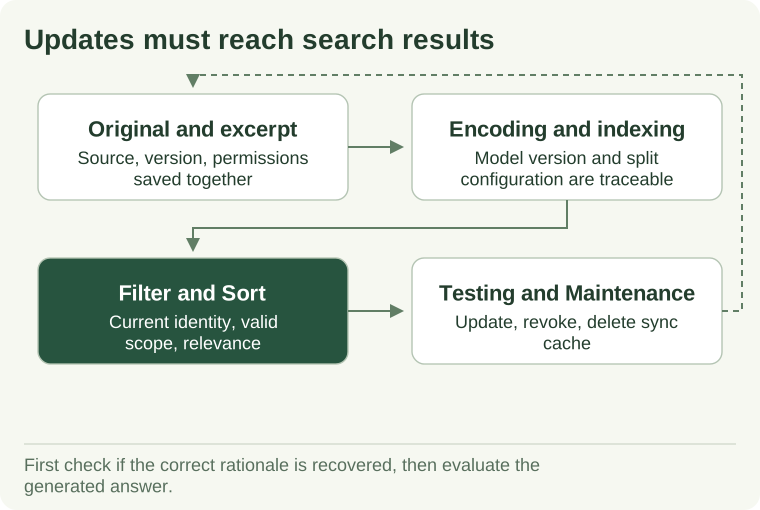
View textual explanation of the diagram
Original snippets are extracted with source information, establishing version and permission indexes. Queries are filtered by actual users and then sorted; results are returned to the original text for verification. New versions or deletion events are synchronized across snippets, vectors, and cache; fixed issues are retested before switching; model upgrades require validation of representation compatibility.
The diagram shows that version, permission, and deletion changes all affect indexing and caching. Updating the original does not mean that queries have started using the new content.
Video script two: How to choose tools suitable for different contexts
AI problems often have multiple viable solutions. The choice is not just about finding "the right tool," but about finding a combination that suits your specific context.
For example, with RAG, there's no need to retrain the entire dataset into the model; instead, you can store the data separately, build an index, retrieve relevant snippets when querying, and then pass them to the model. Vector retrieval can help find content that uses different wording but is still relevant, but it's not magic, and it cannot guarantee that every result is objective or correct.
Both are retrieval-based approaches, but they follow different workflows. One approach is to first query and retrieve top-ranked results before calling the model, then include these results in the input. Another approach is to first pass the query to the model, let it determine which data sources are needed, then have the application call the database or API, retrieve the results, and proceed with generation.
Pre-retrieval structures are relatively simple and may reduce round trips, but the background scope is predetermined by the application. The two-stage tool approach is more flexible and allows for more targeted information gathering, but also increases time, cost, and potential points of failure. "Smarter" or "more accurate" must be measured empirically; it cannot be assumed merely because more steps are involved.
Managers need to ask: How much delay can be tolerated? How to balance speed and accuracy? How complex is the data itself? What can the existing system handle? Can the team support a slower but more flexible approach?
Now let's look at fine-tuning. Should it replace RAG? The answer depends on the question. Fine-tuning can help adjust for repetitive tasks, tone, formatting, or specific behaviors, but it requires prepared examples, training, evaluation, and maintenance.
If facts frequently change, repeatedly updating facts into the model is often inflexible and does not guarantee accurate memory. Retrieval and tools are better suited to provide dynamic references; fine-tuning can target stable behaviors. The two can also be combined so the model works in an appropriate way while incorporating current information.
Do not overlook the components that glue the system together: orchestration, caching, fallback, monitoring, and tracing. Even if the models and retrieval are excellent, a fragile, slow, or failing interface that cannot recover will still leave users with an unreliable experience.
So we need to ask: Can the team sustain support for this technology over the long term? Is switching cloud providers or vendors difficult? Are we essentially reinventing existing capabilities? The choice affects not just the first version, but also how future iterations, maintenance, and scaling will unfold.
Video script three: Treat pipelines as long-term capabilities
We have explored the evolution of data pipelines, what makes data suitable for a task, and the corresponding ethical and usage responsibilities. We also discussed how to build them, select tools, and plan for long-term sustainability.
Keep in mind when continuing to practice: a good AI system doesn't start with just a model; it also relies on appropriate data and on people who carefully manage that data.
Related Reading
How to search for materials, see Vector databases and semantic search ; How to bring search results into the answer, keep watching RAG and business knowledge .
Reference and Extended Reading
The following is an editorial addition.
- Apache Airflow Documentation : English, query workflow scheduling and operation management.
- dbt documentation : English, understand document conversion, testing, and dependencies.
- Overview of Azure Data Factory : Chinese, understand data access and orchestration.