Reading Objectives
This page reviews the evolution of data systems, discusses the breadth and depth of data, and then addresses the ethics, privacy, and usage responsibilities when building an AI data pipeline.
Main text retains the three themes of the original page, followed by four video Chinese script excerpts. Organizational and personnel identities in the materials have been anonymized; data types and inference relationships are preserved as in the original.
1. How data systems have evolved
From simple transaction processing to today's AI platforms, data collection, search, and machine learning continuously reshape how we use information. Understanding this development path helps in planning AI integration within large organizations.
Each technological shift changes the responsibilities of data pipelines: from storing and retrieving data to preparing information for inference and generation. You can consider the journey: where does your system currently stand?
2. Depth and breadth of data in AI projects
AI projects depend not only on how much data is collected, but also on whether the data is diverse and truly relevant to the task .
Original explanation draws on the financial concepts of 'breadth' and 'depth' to assess whether data is suitable for intelligent systems. You need to learn to identify gaps, reduce noise, and enhance meaningful signals Before building a pipeline, you should first consider these questions.
3. Ethical considerations and usage responsibilities in building data pipelines
Data work is not just technical: it also involves privacy, consent and copyright considerations. Whether handling learner records, content materials, or internal documents, it's essential to understand which uses are justified, which practices carry risks, and how to build user trust.
Recognizing common issues, actual protective measures, and why ethics is not a barrier to innovation but rather the foundation for sustainable project operation is essential.
The best AI systems don't start with selecting a model; they begin with data and the people who can manage data effectively.
Video script one: Why discuss data first
To support AI with appropriate data infrastructure, what conditions are required? Below, we first examine how data systems have evolved, what makes data valuable, and how to manage ethics, usage responsibilities, and operational risks.
We will also gradually discuss methods for building and maintaining AI-ready data pipelines, how to select tools based on needs, and how to plan for long-term maintenance.
Video script two: Evolution of data systems
First, walk through the evolution of data systems to see where AI currently stands within today's information systems.
Early computer information systems were primarily used for data collection, validation, and processing. They emphasized transaction processing, such as in Online Transaction Processing (OLTP) systems: storing and updating records for payroll, finance, and inventory.
By the 1990s, data warehouses emerged. Organizations could aggregate data from multiple sources for more comprehensive analysis, observe historical trends, compare different time periods, and support decision-making.
In the 2000s, indexing became a key method for accessing information. Take search engines as an example: users input keywords and receive a ranked result. Previously inaccessible, massive volumes of information became much easier to retrieve.
Tools like Elasticsearch enabled more developers to add search capabilities to their platforms, providing retrieval and relevance ranking for large volumes of text.
In the 2010s, machine learning applications in image-based tasks gained greater attention. Training a model to recognize cats in photos is a simple and intuitive example.
By the end of 2022, large language models began widespread public use. They could not only retrieve information but also generate summaries, organize content, and produce structured outputs, offering diverse data interaction methods.
Shifting from storage and retrieval to generation and inference represents a key evolution in data systems. For project leaders, understanding this process is not just about understanding AI; it also helps in planning integration within the organization.
Ask yourself: Is the current system primarily handling transactions, or does it already have a data warehouse? Has machine learning or more advanced AI services been implemented?
Understanding this history helps in planning infrastructure, defining technical requirements, and discussing realistic expectations with stakeholders. From databases to search, machine learning, and large language models, each step has changed the tasks a system can perform.
Data pipelines have evolved accordingly. They no longer simply move data from one place to another; they now transform, enrich, and clean data to align with AI tasks, enabling the system to produce reasoned outputs and support human decision-making.
Therefore, data pipelines should be viewed as the foundation of modern AI solutions.
Translator's note: These methods coexist. Deploying large language models does not mean that transaction systems, data warehouses, or search have become obsolete. The context of widespread public use in late 2022 is not when large language models first emerged. Generated summaries and inferences do not automatically guarantee factual accuracy and still require verification against source materials and results.
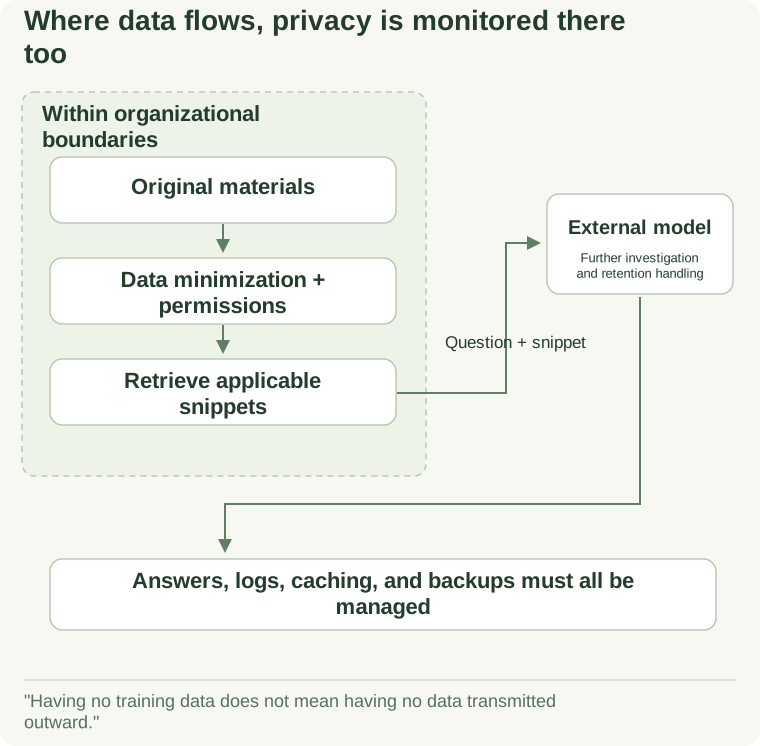
View textual explanation of the diagram
Original data should first undergo a necessity check and minimization, with retrieval of fragments limited to authorized scopes; when using external models, both the query and fragments are transmitted to the vendor. Outputs, access logs, caching, and backups each have specific purposes and retention periods. Data not used for training does not imply it was not transmitted.
Video script three: Breadth, depth, and signals
Why might the same dataset produce vastly different results across different systems? Consider the breadth and depth with which systems utilize data.
In traditional search, users input keywords and receive a list of relevant documents, then must independently interpret the content. With integration of large language models, the system may read, interpret, and summarize answers, eliminating the need for users to open and review every document individually. Thus, the same underlying data is used in fundamentally different ways.
How can we evaluate whether data is sufficient to support such capabilities? The original explanation draws on a 1999 book on active portfolio management in finance. It discusses how to leverage effective information to improve strategies and manage risk. Here, the borrowed concept is not investment advice, but rather the question: 'How much truly usable information is actually being mastered?'
Two terms are especially important. Breadth refers to how many independent information points exist. Depth refers to how much meaningful signal each information point contains, relative to noise, i.e., the signal-to-noise ratio concept.
In the context of AI projects, we can ask: How many distinct and relatively independent inputs are present in the dataset? How strongly is each input linked to the outcome of interest?
Simply collecting the same type of data does not necessarily increase breadth. Disorganized, outdated, or overly general data may also lack depth.
Take an example of a learning path recommendation system. Start by collecting content directories and historical selection records; this reveals available options and past choices. Then, add learning performance, satisfaction surveys, and final completion status, allowing the system to form richer judgments, not just what happened, but also explore potential correlations.
Translator's note: This is an anonymized version of the original example. Adding more fields does not automatically increase the value of information; correlation does not prove causation. Whether data is usable also depends on authorization and privacy compliance.
Managers should ask: How can we know that data collection is sufficient? There is no one-size-fits-all answer, but indicators may include: Are system outputs reliable and relevant? Are there obvious blind spots or biases? Does performance show signs of stabilization after continued data accumulation?
If improvements plateau, the question should be: What kind of information is missing? Is the system simply accumulating more of the same familiar materials, or is it incorporating new inputs with richer contextual information?
Data must also align with actual use cases. High-quality training or testing data should reflect how the system will actually be used in practice.
Structured text formats, such as JSON and YAML, can help express relationships among data. The original explanation notes that large language models often leverage structural information (such as cardinality, option sets, and foreign key relationships) present in these formats.
For instance, if building a recommendation assistant, one should not rely solely on registration records. Additional sources such as notes, policy documents, email exchanges, and PDF explanations may also be needed to understand the actual context in which the assistant operates.
However, simply because these materials might be useful does not mean they should all be included. The source of information matters. Some data may be overly personal, restricted, or explicitly prohibited from use in training. The goal is to obtain rich, relevant, yet fair, transparent, and usage-justified data.
Breadth and depth are practical concerns for planning: Have we collected the right data? Is the marginal benefit of additional data decreasing? Should we shift from quantity to quality? Only by honestly answering these questions can we move forward to the next stage of data pipeline implementation.
Translation note: The original explanation uses a financial text as a methodological analogy. No verified AI performance formula is provided here. Structured formats do not automatically correct erroneous data, permission issues, or model misinterpretations.
Video script four: Privacy, consent, and trust
Now we turn to the ethics and usage responsibilities of building an AI data pipeline. The responsible party does not need to be a legal professional, but should be able to identify issues warranting further verification.
First question: Are the data processed by the pipeline subject to applicable rules? If personal data of learners, content contributors, or employees is involved, a review of relevant requirements is likely necessary. The original explanation mentioned Canada's British Columbia Information Freedom and Privacy Protection regime, U.S. record retention requirements, and the EU's GDPR; internal organizational policies may be even stricter.
Translation note: The original subtitle incorrectly transcribed the U.S. FERPA as 'FRPA'; this has been corrected. The applicable subjects, regions, and data scopes of different regimes are not the same, so this overview cannot be treated as a uniform rule for all projects. Names should be verified. BC Official Regulations 、 U.S. Official Guidance and EU Regulatory Text .
A common protective measure is to remove identifiers (such as names, email addresses, or identifiers) that can link to individuals, under applicable circumstances. These considerations should be made before training or fine-tuning, as once data influences model parameters, post-hoc precise removal becomes difficult.
Translation note: Removing names does not equate to full anonymization. Records embedded in indexes and model parameters differ: indexes can typically be deleted or rebuilt, but handling copies, caches, logs, and access permissions simultaneously is more complex; training impacts within the model cannot be simply and uniformly removed.
Now consider copyright. Even if materials are publicly available online, that does not mean they can be used freely for training or reutilization. Key questions include: Do we have appropriate usage justification? Were the conditions under which data was collected compatible with such use? Does it involve adaptation or redistribution? If using materials provided by content contributors, does the organization have internal policies governing such use?
Privacy and user experience must also be considered. For example, a personal recommendation or application assistant might access learning performance, schedules, personal profiles, or even financial information. Is it clearly explained to users what AI can and cannot see, and does the system provide users with the ability to opt out or make choices?
People are increasingly concerned about how data is used and how decisions are made. Transparency is essential, both in meeting regulatory requirements and building trust.
A team can use one question to evaluate its own practices: If the project were publicly reported, could it clearly explain its purpose and protective measures? If not, where exactly would users, content contributors, or the public have concerns?
Even if one believes minimum requirements have been met, public opposition and reputational damage remain possible. The original explanation referenced a recent negative report, but no verifiable event details were provided; thus, no additional details are included here.
A better approach is to establish advance consent mechanisms, comprehensive documentation, and clearly visible controls, so users understand what the system does, how it operates, and what protections are in place.
When encountering uncertain issues, legal, ethics review, IT governance, or relevant internal review personnel should be consulted. While this may extend early-stage processes, it can help prevent more serious issues later on.
Ethics and usage responsibilities are not opposed to innovation. They form the foundation for long-term project sustainability; trust is built, and only then do users feel comfortable using the system.
Related Reading
The boundaries of data usage can be combined with Four Ethical Principles Continue checking; actual curation and updates will be seen in AI Data Pipeline .
Reference and Extended Reading
The following are editorial additions for queries and learning entry points, which you can refer to as needed.
- Google: Dataset Characteristics (Chinese): Check data volume, labeling errors, noise, and the relationship between data and model performance.
- Google: Data Quality and Interpretability (English): Continue investigating missing values, incorrect labeling, sampling bias, and data interpretation issues.
- NIST Privacy Framework (English/Framework): Begin from an organization's data processing activities to understand risk identification and management of privacy.
- BC Information Freedom and Privacy Protection Act Official Directory (English/Government Document): Corresponds to the official name of the BC regime mentioned in the text; can be accessed for specific provisions.
- U.S. Department of Education: FERPA Official Explanation (English/Government Explanation): Corresponds to the official name and scope of the educational records privacy regime as described in the text.
- EU GDPR Regulation Text (English/Regulation Text): Queries the regulation and specific articles mentioned in the text; applicable scope must be determined based on actual context.