Reading objectives and introduction
This page provides a English translation discussing four commonly encountered AI ethics principles: proportionality, privacy and data protection, fairness and bias mitigation, and transparency and interpretability. Each principle progresses from concept to practical judgment and includes reflective questions or reading suggestions.
Ethical frameworks are not limited to a single type. Different institutions present and categorize them with varying emphases, yet they often revolve around similar issues: how to protect individuals, how to distribute benefits, how to minimize harm, and who is responsible when errors occur. First, examine the four principles, then read the accompanying video script to understand their relationship to broader ethical frameworks.
I. Principle of Proportionality: Are the benefits worth the impact caused?
For AI users, the principle of proportionality is especially important. We have come to recognize that generative AI may bring about environmental, social, personal, and economic impacts. The principle of proportionality requires that, each time it is used, we assess whether the benefits gained outweigh the harms caused across these dimensions.
This is not just asking "Can the tool do it?" but also asking "Is it worth doing this?" Think about:
- Do I really need AI to complete this task? Are there methods with a smaller environmental cost that could achieve the same result?
- Who is involved? Who will be affected?
- What positive and negative impacts will arise for each stakeholder?
Developers also need to consider the principle of proportionality, particularly in the following two aspects.
Efficiency Pay attention to the calculation of investment required to complete a task. When facing the same design problem, seek feasible solutions with lower computational demands, while also considering environmental costs. The original materials use a company's carbon neutrality pledge and afforestation offset projects as examples; this represents a practice overview at the time and does not imply that offsets have eliminated actual emissions, nor does it verify whether the company has fulfilled its current commitments.
Effectiveness Attention: Has AI actually produced the expected effects? "Effectiveness" itself is not simple; at least it involves technical operability, marketability, and meaningful impact on actual users.
Educational technology is a case in point. A product might run smoothly, look appealing, and achieve strong market adoption, yet lack sufficient research demonstrating that it improves learning. To assess its effectiveness, we need evidence of actual impact, market success or technical prowess should not be equated directly with learning gains.
The original reading activity recommends comparing two types of articles: one type discusses the major difficulties in measuring the impact of educational technology, and the other type questions whether the research methods of existing products can prove their claimed effects. The original text does not retain these target URLs, so the reading questions are retained here without guessing or inventing the original links.
II. Privacy and Data Protection: How is information constrained?
AI-specific policies are gradually increasing, but privacy protection cannot rely solely on a single AI law. The original source indicates that actual constraints arise from the interplay of various regulations, including privacy, data protection, cybersecurity, competition, liability, and consumer protection, among which personal information and privacy regulations stand out particularly.
While reading, consider two questions: How are data protection trends evolving across different regions? And how do privacy issues intersect with discrimination, for example, what impacts might surveillance and facial recognition technology have on different groups? The "2025 trends" in the original source represent contemporaneous viewpoints and cannot be automatically extended to current policy conclusions.
Comparison of regions in the original material
The following retains the original table's comparison objects and main content, with corrections to simplifications separately indicated. It is for understanding differences in systems and cannot replace verification of specific legal provisions, their scope of application, and case facts.
Region | The regulations listed in the original materials | The main protection requirements emphasized in the original document |
|---|---|---|
Canada | Personal Information Protection and Electronic Documents Act (PIPEDA) and related amendments to the Digital Privacy Act | Notification, consent, limitation of data collection, accuracy, prevention of unauthorized access, individual access to data and the right to object |
China | Personal Information Protection Law, Cybersecurity Law, Data Security Law | Notification and consent, data localization requirements under applicable conditions, retention periods, and personal information processing responsibilities |
European Union | General Data Protection Regulation (GDPR) | Notification, consent or any other legitimate basis for processing, data minimization, accuracy, retention restrictions, access, erasure, processing restrictions, and security safeguards |
The original table also lists fines: up to CAD 100,000 for Canada; up to RMB 1 million for China; and, by category, up to EUR 10 million or 2% of global annual turnover, and up to EUR 20 million or 4%, for the EU. The original table converts foreign amounts into Canadian dollars. These conversions fluctuate with exchange rates and cannot be treated as fixed standards.
Note: The original table provides an incomplete summary of penalties. Certain intentional violations under PIPEDA may constitute criminal offenses, and CAD 100,000 is not a uniform ceiling for all privacy remedies; Article 66 of China's Personal Information Protection Law specifies additional penalties, such as fines of up to RMB 50 million or 5% of the previous year's annual revenue, for serious violations. Its extraterritorial applicability depends on the specific processing activities defined by law and cannot be generalized as "all data of Chinese citizens both domestically and abroad." The original table incorrectly lists "retention period" as a minimum period; typically, the focus should be on the shortest period necessary to achieve the processing purpose, along with any statutory exceptions. Specific cases should be referenced against the official provisions.
The text then notes that jurisdictions often rely on combinations of several frameworks, with substantial differences in enforcement methods and penalties. It mentions data protection authorities in EU member states and a series of cases involving large platforms. The cumulative fine figure of “EUR 6 billion” given in the text is a historical number without a clear statistical cutoff date; it should not be treated as the current total.
Note: The original text summarizes the consequences of these regulations as "fines rather than criminal charges," which is overly absolute. Violations of privacy may also involve orders, business restrictions, civil liability, and certain actions may constitute criminal offenses. The retention of this comparison serves to illustrate the regulatory approach, and it should not be taken as a basis for excluding other forms of liability.
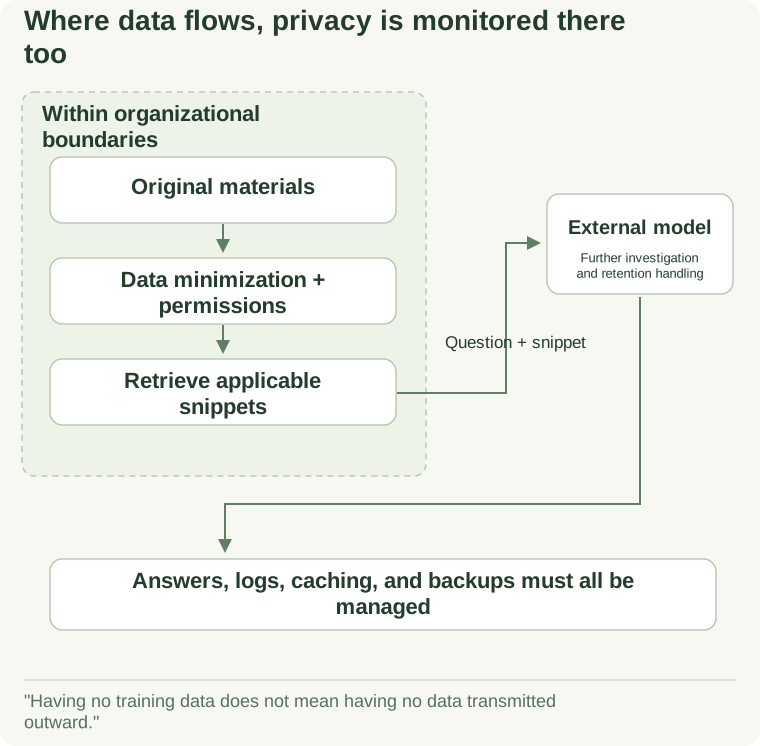
View textual explanation of the diagram
Original data should first undergo a necessity check and minimization, with retrieval of fragments limited to authorized scopes; when using external models, both the query and fragments are transmitted to the vendor. Outputs, access logs, caching, and backups each have specific purposes and retention periods. Data not used for training does not imply it was not transmitted.
The diagram emphasizes first reducing unnecessary personal information, then controlling the scope of retrieval and transmission, and log responses also require access and retention management.
Three. Fairness and Bias-Free Representation: Who is represented, who can use, and who bears the consequences
Fairness and bias mitigation emphasize inclusivity and equal treatment, ensuring no inappropriate discrimination based on race, religion, belief, gender, disability, or other characteristics used to distinguish groups. The original explanation divides the issue into three aspects: representation, accessibility, and output.
Representativeness
First, examine the data used during the development phase: does the relevant population receive adequate and appropriate representation? If loan data primarily comes from males, the system may fail to fairly evaluate female applicants. Even if historical data covers diverse groups, it may still reflect past inequalities; after learning these patterns, the model could amplify existing biases.
Predictive policing is another example. If certain communities have been previously subject to more frequent patrols, they may also have more recorded incidents. Treating recorded numbers directly as a measure of actual risk could further intensify surveillance in these communities, creating a feedback loop. The issue here is not merely "do we have data," but also how the data is generated and what consequences its use may have.
Accessibility
Do different communities or groups have access to advanced technologies? Before the rise of AI, the digital divide already existed, both within countries and between countries and regions. Factors such as infrastructure, cost, and language all influence whether technologies can be actually used.
AI and generative AI could widen these gaps rather than naturally eliminating them. We should observe who gains access to devices, connectivity, language support, and usage skills, as well as who ultimately benefits from technological advancements.
Output
Generative AI is not only used for classification or prediction, but also generates text and images, so biases will also appear in "how people are depicted," "which occupations are associated with certain individuals," and "whether certain expressions exclude specific groups."
The original reading activity recommendation is to separately read studies on the bias of image generators and text generators, and to choose either academic papers or more accessible explanations. When comparing, pay attention to: which prompts, which models, and which version (at what time) the studies examine; as well as how bias is defined and measured; do not treat a single example as representative of the entire system's performance.
IV. Transparency and Explanability: What Can Be Checked, What Can Be Questioned
Transparency and explainability are typically discussed alongside reliability, accountability, and human rights as the foundation of "trustworthy AI".
Transparency Attention: To what extent can stakeholders inspect the system and its decision-making processes? What data is used? What data processing methods and algorithms are employed? Which model features influence judgments or outputs? Can these elements be audited?
Explainability Focus more on concrete outcomes: whether users, regulators, and others can understand why a particular decision was made, and whether that decision can be reasonably explained.
Both are linked to redress. If the outcome of a system infringes upon human rights or results in unequal treatment, individuals should have avenues to lodge complaints and access independent review. The original text uses a common commercial scenario as an analogy: if a business refuses service due to your height, you might file a complaint or seek legal remedies. The responsibility chain in AI can be more complex, but complexity should not be a reason for no response.
The original reading activity invites further exploration of two questions: why is transparency and explainability difficult in practice? What technical challenges exist within this? While reading, it is important to distinguish among three different levels: "telling users that AI is being used," "disclosing development details," and "explaining a specific decision."
After completion, it can be used Ethical Reflection Exercise Check one of your frequently used apps.
Video transcript: How do different ethical frameworks connect to one another?
There are many AI ethics frameworks; here, four perspectives are selected: the European Union, IEEE, OECD, and UNESCO. The original explanation places the first three around 2019, while marking the UNESCO document as from 2022.
Note: The UNESCO Recommendation was adopted in 2021 and published in 2022. The following classification of principles is based on the original explanation and does not replace the complete structure of the official document.
These organizations have different roles. IEEE is a professional organization focusing on engineers and related professionals; the European Union, OECD, and UNESCO involve regional, country-specific, and transnational governance more prominently. As a result, their emphasis and language differ.
The original explanation outlines different principles based on varying numbers, while also reminding that some titles combine multiple concepts together. Therefore, one cannot simply judge whether frameworks are the same or different based on terms like "seven points," "five points," or "six groups."
Focus of the EU, IEEE, and OECD
The original explanation summarizes the key points of the EU, including the protection of human autonomy, avoidance of harm, fairness, explainability, privacy, and data protection, as well as data quality, completeness, and access. It particularly focuses on how data is used and processed.
IEEE emphasizes human rights, human well-being, accountability of designers and operators, transparency, and the mitigation of abuse. It includes both builders and users, which is noteworthy. Misleading information is one of the abuses that needs to be prevented.
The OECD particularly emphasizes ensuring that all people share the benefits of AI, including both within a country and across borders. It frames this direction as inclusive growth, with the related issue being the digital divide: who gains access to technology and who does not; who receives opportunities and who is left behind.
The digital divide was not a phenomenon that emerged with the advent of AI. As originally mentioned, the term had been widely used in the 1990s, even though there had always been aspirations for technological leaps, the gap did not vanish automatically.
Other OECD directions include human rights, transparency and interpretability, robustness and safety, and accountability. You will notice certain concepts recurring, just presented in different organizational forms.
Principle of Proportionality and the Prevention of Harm
The original explanation consolidates several UNESCO principles into a few groups, beginning with the proportionality principle and the principle of avoiding harm. The proportionality principle directly compares benefits and costs: is the help provided by AI worth the harm already caused or potentially caused?
Causing no harm is a difficult goal to achieve simply. It requires balancing considerations such as environmental observation, accuracy, human capabilities, and interpersonal relationships. The original explanation uses the tension between computational resource consumption, reduced thinking practice, changes in interaction methods, and the trade-off between speed and accuracy to illustrate this.
Note: The original text claims certain costs as inevitable, for example, AI is always less environmentally friendly than human processing, or always detrimental to cognition, such absolutist statements are overly general. A more accurate approach would compare specific alternative solutions and actual usage patterns. What should be preserved is the issue of trade-offs, not universal negative conclusions.
Therefore, the principle of proportionality does not merely state that technology carries risks, nor does it only claim that it enhances efficiency; instead, it evaluates specific risks and benefits within the same contextual framework.
Safety, Assurance, and Privacy
Safety and assurance are broader than privacy. The system's actual effectiveness, its suitability to the usage environment, and its potential harm to certain groups can intersect with fairness issues; from a cybersecurity perspective, it also depends on whether it is adequately protected and whether it is easily misused.
Privacy and data protection then ask: does the disclosure, sale, or improper sharing of data harm individuals? Does it protect information from misuse? These questions are interrelated and cannot be adequately addressed by a single setting switch.
Multi-party governance and cooperation
Another set of principles focuses on multi-stakeholder participation and collaboration. The original explanation states that individual users may not directly engage in policy negotiations, but they are already subject to complex data protection, access, and jurisdictional rules.
In some countries, policies respond to one another, creating competition or conflicts over issues such as who can access what data, when access is granted, and who has the right to request disclosure. Calls for cooperation aim to jointly address these cross-border impacts, rather than having each participant act solely in its own interest.
Duties and Accountability
Accountability runs through multiple frameworks. Systems designed poorly, or lacking clear owners or lines of responsibility, make it difficult to determine who should be held accountable for the consequences. Poor development or misuse may also lead to discrimination, unfairness, and other social harms.
Therefore, it is necessary to have traceable accountability relationships, appropriate review and correction mechanisms, ensuring that someone is responsible throughout the system (from development to actual operation) rather than concluding the discussion with "an AI decision."
Transparency and explainability
It is possible to let people know that they are interacting with AI. But deeper transparency (covering processes, mechanisms, algorithms, data, and other inputs) would require verification by an appropriate third party.
Making this information public might also encounter intellectual property and commercial confidentiality concerns. Institutions' reluctance to share is not the only source of difficulty; the technology itself may also be difficult to explain.
Explainability aims to connect inputs with specific outcomes: why was this decision made in this case, is it reasonable, and can it be justified? These questions are central to public trust.
Complex models may give rise to what is known as the "black box" problem: even if transparency is desired, it becomes difficult to fully trace the entire process behind a particular output. The fact that this is difficult should not be a reason to withhold responsibility or remedies.
If a person believes that AI has had an adverse impact on them, can they raise concerns with the appropriate authorities, an independent third party, an arbitrator, or a judicial body for resolution? Just as individuals have complaint mechanisms in ordinary commercial settings, AI systems should also be subject to oversight and review under corresponding regulatory frameworks.
At the end of the original explanation, it invites learners to select materials that are either more accessible or more specialized based on their interests and background. They can first become familiar with common principles, then gradually deepen their understanding through specific applications and comparisons across different frameworks.
Related Reading
use Ethical Principles Reflection Exercise Check a frequently used app, then Trustworthy AI Framework Compare oversight and accountability at the organizational level.
Reference and Extended Reading
The following is the entry for editorial supplements and translation notes verification, without falsely claiming links to original articles that have not been preserved.
- UNESCO AI Ethics Recommendations : English, verify time and ratio, fairness, privacy, transparency, and other formal principles.
- OECD Artificial Intelligence Principles : English, understand the relationship among inclusive growth, human rights, transparency, resilience, and accountability.
- Canadian Privacy Commissioner: Requirements for reports on security breach disclosures : English, query responsibilities and violation explanations related to PIPEDA.
- Article 66 of the People's Republic of China Personal Information Protection Law (official text) : Chinese, verify the specific clauses on penalties and legal responsibilities.
- EU GDPR official text Multilingual, query compliance requirements and penalty classification under Article 83.