Reading instructions
This page is a English translation of the lecture notes, discussing clouds, fog, and edge computing, accelerated computing, rights issues related to generative content, and business opportunity evaluation. Since no corresponding oral transcript was obtained, any remarks beyond the lecture notes are not included. The legal sections retain their historical context and use footnotes to distinguish points that require correction or further verification against current regulations.
I. Cloud, Fog, and Edge Computing
Cloud computing Deliver server, storage, networking, analytics, and intelligence resources on-demand over the internet, enabling organizations to meet infrastructure needs through scalable services.
Mist computing Offload some processing between the data source and the cloud, such as on-site gateways or intermediate nodes, so that data is processed closer to where it is generated, reducing the amount of data sent to remote locations and shortening response times for certain operations.
Edge computing Processing and analysis take place locally, closer to the device or data source, reducing the volume of returned data and round-trip latency. This does not necessarily mean being entirely disconnected from the cloud; the three approaches can form parts of the same system.
Note: The original text describes fog computing as "no longer requiring data to be sent to the cloud." This should be understood as reduced data return, not the complete elimination of cloud usage in all fog systems. Privacy, network conditions, operations, and version synchronization also influence deployment decisions.
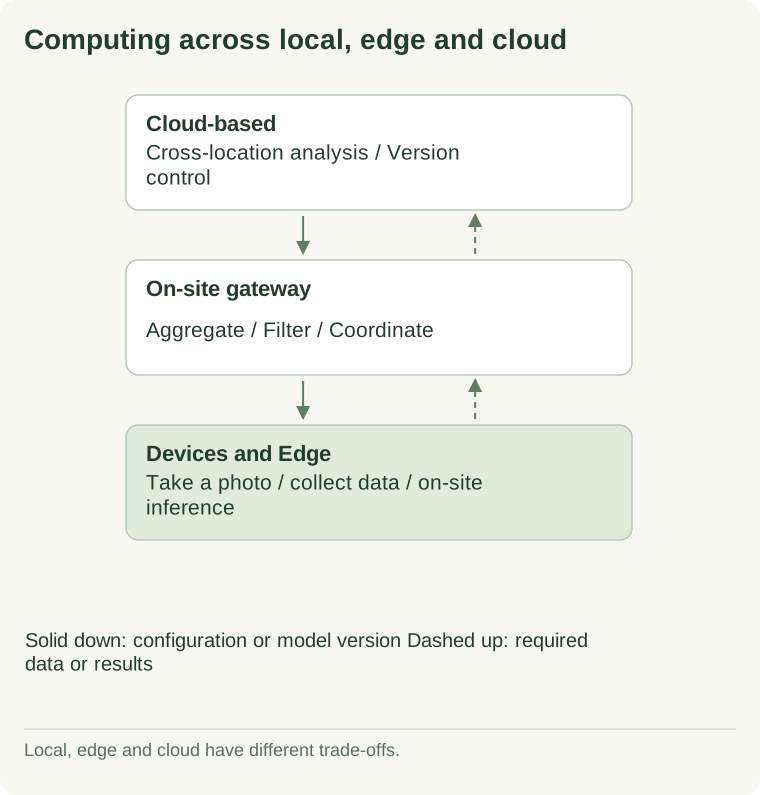
View textual explanation of the diagram
Edge proximity sensors capable of on-site inference; on-site gateways can aggregate, filter, or coordinate; cloud-based systems can perform centralized analysis, version management, and training. The actual distribution of these tasks may vary, and local processing still requires access control, updates, and log protection.
The device in the figure handles real-time processing, on-site nodes perform aggregation, and the cloud is responsible for cross-location analysis and version management, demonstrating that they can work collaboratively rather than replacing each other.
Two: Why is AI often used for accelerated computing?
Data-intensive work requires appropriate hardware and software. Accelerated computing uses specialized hardware to offload parallelizable operations from general-purpose processors to devices such as GPUs, improving the efficiency of certain tasks.
CPU is the central processing unit, responsible for interpreting and executing a large number of instructions within the device. GPU is a graphics processing unit, originally widely used for graphics rendering, featuring a structure suited for performing a large number of similar operations in parallel, and thus is also commonly used in deep learning.
The original lecture notes simplify CPU as serial and GPU as parallel. This helps build intuition, but modern CPUs also have multi-core architectures, vector instructions, and parallel capabilities; GPUs are not faster for all tasks. Consider the operation type, data movement, memory, software implementation, and power consumption.
Accelerated computing typically involves collaboration between CPUs and specialized hardware, rather than simply "replacing the CPU." The original material highlights NVIDIA's chip applications in AI data centers to illustrate this industry trend and does not constitute a current product or investment recommendation.
Three, training, data usage, and output responsibilities are separate issues.
The original lecture notes discuss a copyright case involving Meta and Anthropic that arose in the U.S. in 2025, and summarize certain judgments from the training data used at that time as "transformative and potentially constituting fair use." It also cautions that judicial disputes may change with appeals and subsequent proceedings.
A key distinction to retain is: the legal evaluation of training behavior does not automatically determine whether data acquisition and retention are lawful; model outputs may also raise independent issues. The original lecture notes summarize these cases as "training did not infringe copyright," a characterization that is too broad and cannot be generalized as a standard rule applicable to all models, all works, all methods of acquisition, or all jurisdictions.
Fair use is a rule determined by specific legal frameworks and assessed on a case-by-case basis, not a universal passkey allowing anyone to use any protected work. Here, historical discussions and factual evaluations are preserved, without treating past news summaries as complete representations of current case circumstances.
The original uses the analogy of "a person learning to write new content after reading" to explain transformative use. Such an analogy can aid in understanding the issue, but it cannot replace a detailed analysis of the work's origin, copying, market impact, and specific actions.
Four: What legal issues are associated with generative AI?
Regulatory frameworks and progress vary across jurisdictions, with the original materials highlighting EU risk-based governance, the United States' multi-layered rules, and discussions in the UK, Canada, and New Zealand. These represent historical overviews; they cannot be used to infer that any region currently lacks new regulations or employs only a single regulatory approach.
Specific issues include: how training data is collected and used; whether outputs infringe upon existing rights; whether outputs themselves can be protected; whether the sources and accuracy of content are clearly disclosed; how to protect minors; and how to clearly define responsibilities and avoid harm during development and usage.
Five: Who owns AI-generated output is different from whether copyright is obtained.
The original text states that in many jurisdictions, copyright protection emphasizes human creativity. Content produced with minimal human involvement and generated automatically by systems may not qualify as a human work and thus may not be eligible for copyright protection; platform terms also influence the rights arrangement between parties.
The U.S. Copyright Office distinguishes between AI-generated content and human creative contributions. Human expression, selection, arrangement, or modification may involve protectable elements, but merely providing prompts does not automatically establish copyright.
The UK has different statutory provisions regarding computer-generated works, where a person who makes the necessary arrangements is deemed the author; the specific application still depends on current legislation and factual circumstances. Canadian sources highlight that issues remain regarding human authors and limited human input. Different jurisdictions cannot be addressed by a single standard of judgment.
Note: Copyright office policies, platform terms of service, court judgments in individual cases, and whether a particular output infringes third-party rights exist at different levels. Even if a platform transfers output rights to users between parties, it cannot create copyright that the law itself does not recognize, or eliminate third-party rights.
Six: How to Assess a Person's Creative Contribution
There is no "percentage of human involvement" applicable to all jurisdictions and all works. The lecture notes propose the following observational dimensions to help document the process, and these should not be construed as uniform statutory lists across different regions.
Dimension | What needs to be observed |
|---|---|
Intent and Creative Direction | Do people set goals and actively control the process, rather than passively accepting the final product? |
Original expression | Does anyone have creative judgment and identifiable expression, rather than just technical input? |
Creation and Revision | Whether substantially adjusting, restructuring, or altering the results, rather than merely changing the color or tone mechanically |
Selection and arrangement | Do the selection of materials, structure, and composition reflect human expressive choices? |
Content creation combined with human input | Are scripts, sketches, or narratives created by the person themselves retained in the final product? |
Process record | Can it be explained how prompts, iterations, and specific decisions occur? |
Control of finished products | To what extent does the final expression reflect a person's concrete conception? |
Differences between tools and ghostwriters | Is AI serving as a tool to assist human creativity, or is human involvement limited to merely triggering content generation? |
Insufficient contribution | Input only general prompts or perform mechanical operations; it does not necessarily meet the protection conditions. |
The original material emphasizes that originality does not mean high artistic quality. What matters is an identifiable human creative contribution that meets the applicable legal requirements. A long prompt or many iterations cannot by themselves guarantee copyright protection; the actual development and expression of the work need to be assessed.
When disputes arise, generate logs, process screenshots or recordings, file metadata, collaborator notes, and other evidence that may help understand how a final product was created. Documenting the process is useful, but private data should also be protected, and logging should not be treated as a necessary step for public disclosure.
Seven. Platform Terms and Data Usage
The platform may have different arrangements regarding inputs, outputs, licensing, and commercial use. The example provided uses the terms from OpenAI and Midjourney, but package offerings, training configurations, and commercial terms may vary and cannot be reliably inferred from previous versions.
OpenAI's Personal Services Terms establish rights and ownership provisions between the parties, within the limits allowed by applicable law, whereby users retain rights to inputs and ownership of outputs; they also include data usage and removal from training arrangements. Specific terms applicable to a given product should be consulted, and personal service data handling practices should not be conflated with those of enterprise or API data processing.
Note: The original lecture notes place "exit training" and "starting from scratch each session" together, which may lead to misunderstanding. Model training, chat history, memory functions, and current context are distinct mechanisms and should not be equated one-to-one. Whether or not payment is made is not a simple dividing line for individual users regarding the ability to exit training.
The original material concludes with four reminders: evaluation of training does not equate to responsibility for outputs; outputs may still infringe upon others' rights; process records are valuable; jurisdictional differences are important. Actual use requires simultaneous review of local regulations, human contributions, source licensing, and platform terms.
Eight. Where to discover business opportunities
First examine processes with rich materials but underutilized, such as maintenance records, customer feedback, and quality measurements; then look at repeatedly performed tasks with predictable steps, such as forms, daily communications, and standard approvals.
The third category involves decision points that require prediction, such as resource allocation and inventory planning; the fourth category consists of resistance frequently encountered by customers or employees, such as difficult-to-find information or long waiting times.
The original material cites an anonymous example of reducing query time from 45 minutes to 10 minutes through semantic retrieval. It illustrates how goals can be defined, but does not provide verifiable sources and therefore cannot be considered a general effect.
Nine. How to systematically evaluate opportunities
Technical feasibility does not necessarily mean it is worth implementing. Four conditions need to be checked.
"Conditions" | Core issue | Why is it important |
|---|---|---|
Problem definition | Is the challenge specific, clear, and measurable? | Vague questions lead to unclear solutions and evaluations. |
Data conditions | Are there sufficient, relevant, and high-quality materials available? | What matters is data that fits the problem, not simply having more data. |
Integration possible | Can we access existing tools and processes? | An isolated system may struggle to generate practical value |
Business value | Does it support goals such as cost, revenue, or services? | Time and resource investment should have reasonable justification |
Each role may contribute experience: front desk staff identify scheduling difficulties; coordinators improve weekly reports; department managers spot gaps in processes; organizational leaders redesign services. Even when tools are widely available, understanding the business and exercising judgment remain essential.
10. Comprehensive Practice
Original lecture notes once again present a five-minute business briefing and a seven-part structure, and Comprehensive Operation Opportunity Solution Repeat: place all requirements uniformly on this page. Here, retain its position: after understanding technology, boundaries, and evaluation, connect the questions, processes, indicators, and risks into a scheme.
Related Reading
After discovering an opportunity, use " Operations Plan Practice Connect processes, metrics, and risks; see separately for content creation impact Generative AI Risks and Responsibilities .
Reference and Extended Reading
The following is the entry for editorial supplements and translation notes verification, not legal advice on any specific work or case.
- U.S. Copyright Office: AI and Copyright : English, query AI-assisted creation and copyright report.
- UK Government: AI and Copyright Report : English, query discussions on British systems and policies, note publication date and scope of application.
- OpenAI Terms of Service : English, query the actual applicable input and output parameters and usage conditions of the product.
- NVIDIA: Accelerated Computing : English, understand how the CPU and accelerators divide responsibilities.