Reading instructions
This page is a English translation of the lecture notes, presenting concepts, hints, tokens, vectors, and application plans in the original knowledge order. There is no available spoken transcript for this comprehensive explanation in the current materials, so the slide points will not be expanded into fabricated spoken content. Information on original identity, connections, and related affairs has not been included.
1. From popularity to clear questions
The goal of learning AI fundamentals is to identify opportunities, leverage capabilities, while recognizing risks and ethical implications, thereby making informed decisions. Understanding what AI is also requires deeper insight into how it can support work, and how to transform curiosity into practical skills.
AI is not mysterious. Complex behaviors are achieved through large-scale mathematical computations, but from a strategic perspective, data, context, and objectives must also be considered. Rather than focusing solely on how exciting the tools are, start by clearly defining the business problem and how the system enhances human capabilities.
Definitions of AI vary across disciplines, and the terms are not always used consistently. Machine learning and deep learning are often used interchangeably, but they are not synonymous. A classic definition views AI as the science and engineering of creating intelligent machines and programs; research in artificial intelligence does not necessarily require replicating biological mechanisms.
The original lecture handout compares AI with rule-based programs: traditional programs execute based on clear "if...then..." logic; learning systems discover patterns from data and apply them to new situations. It should be noted that this primarily describes machine learning and does not exclude rule-based AI; once a model is deployed, it does not automatically learn under all circumstances.
Two. Five Basic Words and a Cooking Analogy
"Terminology" | Meaning | "Cooking analogy" |
|---|---|---|
Data | Text, numbers, images, or sounds used for learning; quality and representativeness affect the results | Raw materials |
Algorithm | Steps for handling data, identifying patterns, or making predictions using mathematical methods | Recipe |
training | Applying learning methods to materials, adjusting the model process | cooking |
model | The structures and parameters trained carry the learned patterns. | A well-cooked dish |
inference | Use the model to process new inputs and generate predictions or content | Serving and eating |
Analogies help distinguish between processes and products, and one should not regard a model as truly understanding the task. Training may also introduce biases present in the data into the system.
Three: AI is a broad umbrella category
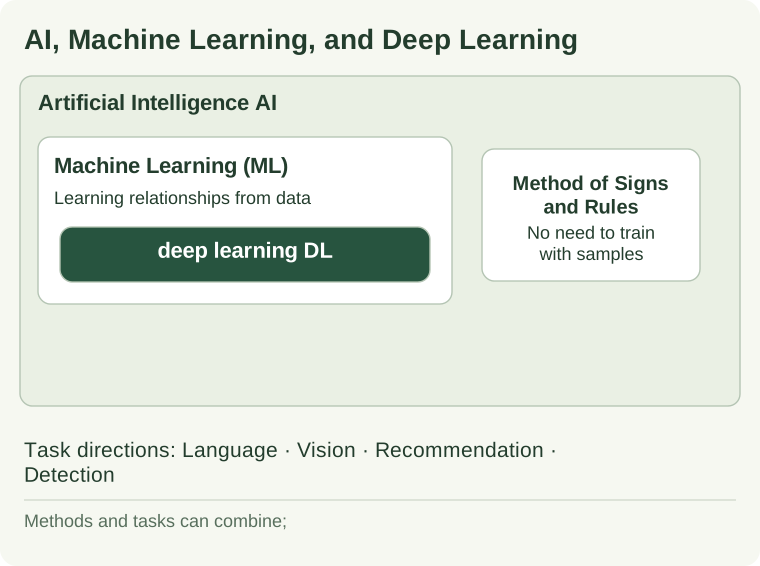
The original list includes fields such as machine learning, natural language processing, computer vision, speech recognition, robotics, expert systems, machine reasoning, neural networks, data mining, and autonomous agents. These categories are not mutually exclusive; technologies, tasks, and systems can be combined.
View textual explanation of the diagram
AI is a broader field; machine learning fits models from data, while deep learning uses multi-layer neural networks. Symbolic and rule-based methods do not necessarily belong to machine learning. Tasks such as language, vision, and recommendation can adopt or combine different approaches.
Illustrate the distinction between containment relationships and task directions: Machine learning belongs to AI, and deep learning belongs to machine learning; language and visual tasks may employ different approaches. Not all names in the original diagram should be considered at the same hierarchical level.
Three ways of learning
Supervised learning uses samples with correct answers, such as labeled spam emails, to learn how to generalize to new inputs.
Unsupervised learning does not have predefined target labels; instead, the system identifies hidden structures, such as grouping users who exhibit similar behaviors or emotional responses.
Reinforcement learning gradually adjusts strategies through actions, feedback, and rewards. For example, a game agent takes actions, observes the outcomes, and learns over multiple trials which actions lead to better long-term returns.
Historical data also includes past decisions. If past injustices existed, the training might learn the same patterns. Therefore, data selection is not only a technical issue but also a governance issue.
Natural Language Processing in Daily Work
Natural language processing enables systems to process, interpret, and generate human language and engage in interactions. You may have encountered it in spell-checking and grammar correction, voice assistants, customer service chatbots, meeting transcription, email categorization, employee sentiment analysis, and resume parsing with keyword extraction.
Many chat, filtering, survey analysis, or drafting tools rely on natural language processing. Understanding these mechanisms helps in comprehending both their capabilities and failure modes.
Original lecture again uses a car as an analogy: mathematics is the engine, data is the fuel, and strategy is the driver. You don't need to build the engine yourself to drive a car, nor do you need to learn how to train models before using them; but you do need to know where it's appropriate to go and where it's not, as well as what questions to ask.
IV. Capabilities and Boundaries of Generative Systems
Generative AI produces text, images, audio, code, or data based on training patterns. Language models predict tokens based on context; when combined in large numbers, they can generate responses that appear to have understanding.
It excels at drafting, summarizing, restructuring, translation, and format conversion, as well as helping locate information within long texts. It cannot guarantee accuracy and does not automatically know any missing organizational guidelines, collective agreements, or specific context. Major ethical, legal, and business decisions still require human judgment.
Note: The original lecture summary characterizes the model as "able to match patterns but incapable of reasoning." This emphasizes that fluent expression should not be taken as a reliable judgment, but this characterization is overly absolute. In reality, the system can perform well on certain reasoning tasks, while it may fail on novel or context-sensitive problems; performance should be validated on a case-by-case basis.
Five: How to Provide Effective Prompts
Prompts serve as the starting point for input to the system and can include instructions, conditions, parameters, and examples. Examples help align the output within the current context, and do not equate to retraining the model.
"Instead of 'give me marketing ideas,' specify the product, target audience, and required quantity; instead of 'write a rescheduling email,' state a two-week delay, the reason, and a contingency plan; instead of 'a house,' describe modern minimalism, large windows, pines, sunset, and photographic effects."
The six dimensions of CO-STAR
The original lecture notes used CO-STAR to organize prompts. Below is also the translation of the text from the original image, not just the titles extracted by the reading tool.
Dimension | What should be explained? | The explanation and examples in the original image |
|---|---|---|
C: Background Context | Roles, Organizations, and Contexts | The clearer the background context, the less the system relies on guessing |
O: Objective | What does the system need to accomplish? | "Help me think it through" is not the same as "give me a usable draft." |
S: Style | Writing style or expression method | Plain language for employees, different from formal reports for management |
T: Tone | Neutral, empathetic, firm tone | In labor and employment relations, tone can affect the relationship and legal consequences. |
A: Audience | Who will read the results | Employee representatives, management, new hires, and legal counsel require different communication approaches |
R: Response Format | How to organize finished products | List number, draft email, summary table, and other formats may affect whether they can be used directly |
This framework helps express requirements and does not guarantee the accuracy of the information or the correctness of the output. Verification is still required when the content is critical.
Six. Token: How does the model process text?
Text is first split into tokens, which may correspond to words or just parts of words; tokens are then mapped to numerical representations. The model performs computations on these representations and generates subsequent outputs based on prior context.
The original lecture used "automatic completion at a granularity finer than individual words" to build intuition. It does not mean the model searched the entire internet and retrieved facts one by one, nor does it imply that all data has been seen by the model.
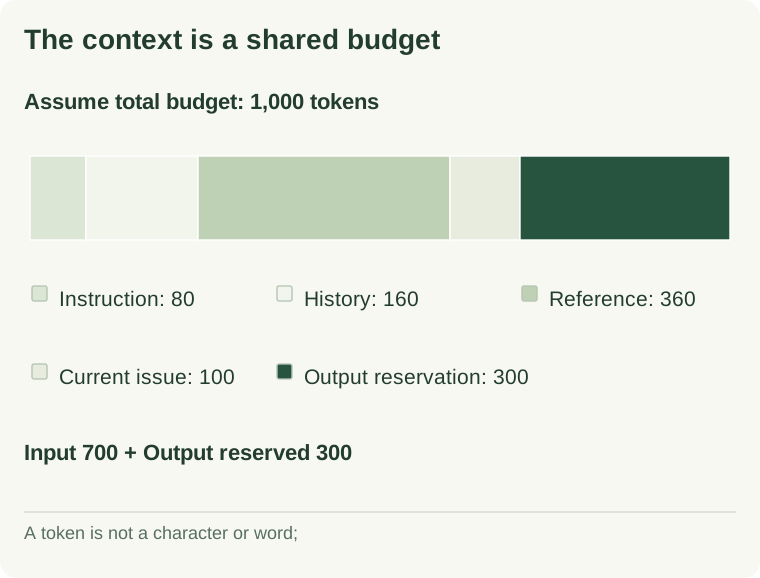
This affects three things. First, the context window is limited, so very long documents may exceed input budget or make it difficult for the model to stably focus on earlier content. Second, rare abbreviations and domain-specific terms may be split into multiple fragments, requiring definitions and context to reduce ambiguity. Third, statistically plausible continuations do not necessarily mean the content has been fact-checked, which relates to hallucination issues.
View textual explanation of the diagram
Assume a total budget of 1000 tokens, with 80 for instruction, 160 for history, 360 for references, 100 for question, and 300 reserved for output. The input portion totals 700; appropriate space must be reserved for output. Actual products may have separate input, output, and other constraints; refer to the corresponding model guidelines.
The numbers in the figure are assumed budgets used to illustrate the shared capacity occupied by instructions, history, context, questions, and outputs, not actual limitations of any specific model.
Seven. Vectors and Semantic Search
People remember "the email that proposed a new activity idea" or "a picture of a beach sunset"; computers typically store numbers, dates, file types, and tags. This gap between meaning and field is the semantic chasm referred to in the original lecture notes.
Embedding represents content as comparable vectors. For example, the word "quick" in the illustration is [0.2, -0.5, 0.8, 0.1, -0.3, …] , fast as " [0.3, -0.4, 0.7, 0.2, -0.2, …] , the original image is assumed to be 512-dimensional. They are closely aligned within the same representation space, which can help identify semantic associations.
Note: These coordinates are illustrative and cannot be used to prove semantic equivalence across the displayed dimensions. Embedding models form representations through training; similarity calculations during query time typically do not require retraining. Moreover, it is not the case that every language model automatically stores vectors into a vector database after processing tokens. Indexing, permissions, and updates must be managed separately by the application.
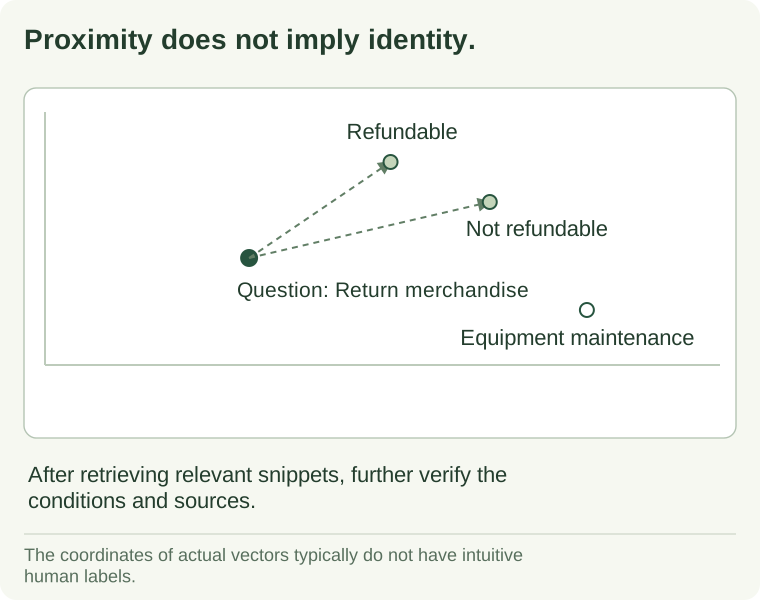
Semantic search may help with faster decision-making, uncovering unexpected associations, reducing retrieval time, providing a natural language interface, and better leveraging organizational knowledge. However, vector proximity only indicates some level of relevance and does not guarantee factual accuracy; "refundable" and "non-refundable" may also be very close in vector space.
View textual explanation of the diagram
Vector similarity helps identify candidate materials that are semantically related. The proximity between "refundable" and "non-refundable" in the figure indicates that semantic similarity does not guarantee consistent conclusions. Further review of conditions, versions, and the original text is still required; actual embeddings typically have more dimensions.
Eight: Failure Modes to Understand Before Going Live
Question | What it means in practical work |
|---|---|
Hallucination | A smooth and confident answer might be wrong; important decisions require verification |
Historical bias | Trained on hiring decisions from the past decade, may inherit the inequalities therein |
Reasoning gap | Novel tasks requiring multi-step analysis or heavy reliance on background knowledge may result in unexpected errors. |
Background missing | Protocols, industry standards, and current circumstances not provided should not be assumed to be known by the system. |
Understanding limitations is part of responsible usage. Relying on training data without context is precisely why prompts and provided information are important.
9. Apply knowledge to business solutions
The final lecture handout presents a comprehensive project: as an internal member of an organization, identify issues that could improve operational efficiency, investigate potential solutions and their feasibility, and present recommendations in a brief report lasting five minutes or less.
This section is about " Comprehensive Operation Opportunity Solution Repeat: Place the full task and the seven-part structure on this page: Executive Summary, Operational Opportunities, AI Applications, Pre- and Post-Process Flows, Evaluation Metrics, Operational Risks, and Ethical Impacts. Use a real or fictional organization, with a clear, coherent, and well-justified business argument as the focus.
Related Reading
The specific differences of model customization are as follows: AI Services and Algorithms ; Semantic representation of how to access business queries, see further Vector databases and semantic search .
Reference and Extended Reading
The following is an editorial addition.
- Google: Getting Started with Machine Learning : Chinese, review data, training, models, and inference.
- Google: Embeddings : Chinese, query vector representation and its training implications.
- NIST AI Risk Management Framework : English, connect technical boundaries to evaluation, responsibility, and usage conditions.