Reading Objectives
After reading this page, you will be able to: understand what artificial intelligence is and how it differs from traditional computing; identify and compare the main AI technologies; recognize common AI applications in products and industries; distinguish genuine AI capabilities from marketing claims; and find opportunities to apply AI in your own work.
This page presents the main knowledge text, followed by complete translated transcripts for four accompanying videos. There is some overlap, but each also contains its own examples. You can read the main text first, then follow the transcripts to understand the explanations.
1. Introduction to Artificial Intelligence
What is Artificial Intelligence
Artificial Intelligence (AI) refers to computer systems capable of performing tasks typically associated with human thinking, such as pattern recognition, language understanding, decision-making, and learning from experience.
How it differs from traditional computing
Comparison Dimensions | Traditional Computing | AI Represented by Machine Learning |
|---|---|---|
Processing Path | Input → Pre-written rules → Output | Input and example outputs → Learn patterns → Apply to new inputs |
Source of Rules | Manually written by humans | System discovers patterns from examples |
How to Update | Usually requires manual program updates | Can be improved through more data and continued training |
What It Can Handle | Depends on explicitly defined scenarios | Can detect complex patterns that are difficult for humans to describe in programming terms |
The fundamental difference lies in how problems are solved; this also determines which types of challenges each approach is best suited for.
Here are five core concepts:
- Data : raw information used for learning, including images, text, sound, and numbers.
- Algorithm : a set of instructions or mathematical processes used to process data.
- Model : a statistical structure used to represent the content learned by the system.
- Training : the process of adjusting internal parameters and building the model.
- Inference : using a trained model to predict or judge new data.
The core idea is: machine learning systems learn patterns from data and apply those patterns to new situations.
Note: This page contrasts learning-based AI with hand-crafted rule systems to introduce machine learning. AI encompasses a broader range of systems, including those based on rules and knowledge representation; 'learning' is not a necessary definition for all AI. Trained models deployed in practice do not automatically update after seeing a single input; they require explicit training or update mechanisms.
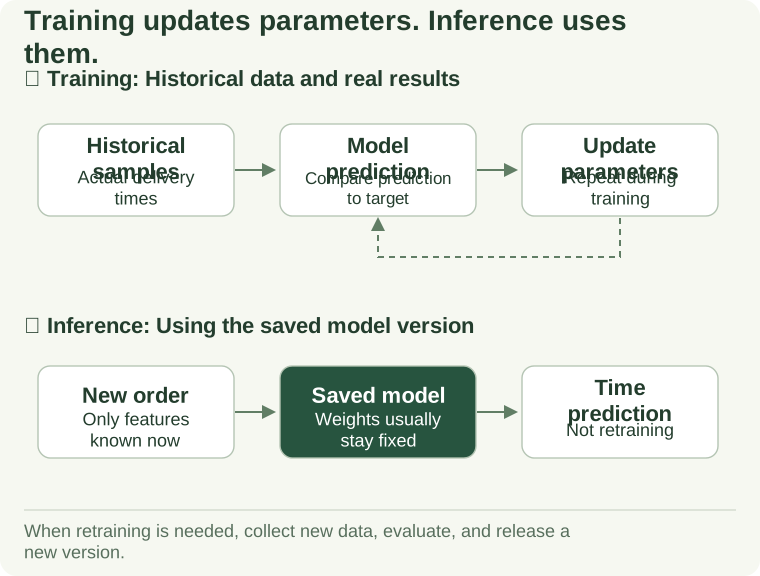
View textual explanation of the diagram
The upper training path feeds historical samples into the model, compares predictions with targets, and updates parameters through optimization. The lower inference path inputs new orders into the saved model to generate predictions; increased usage does not imply automatic parameter learning.
2. Key AI Technologies
Machine Learning
Machine Learning Let the system improve its performance from data, rather than writing explicit rules for every situation. Here we introduce two main types of learning approaches.
Supervised Learning Uses labeled data, i.e., examples with already provided correct answers. The model learns how to predict labels for new data. Examples include spam filtering, credit scoring, and disease diagnosis. Think of it as learning with timely human feedback.
Unsupervised Learning Uses unlabeled, unclassified data. The system discovers hidden patterns or groups on its own, such as customer segmentation and certain anomaly detection tasks. It's like exploring an unfamiliar city without a guide.
Neural Networks
Neural Networks Is a type of machine learning model inspired by the structure of the human brain. Its basic structure includes:
- Input layer : receives raw data.
- Hidden layer : processes information.
- Output layer : Provide the final prediction or judgment.
- Weight : A numerical value that determines the degree of mutual influence between nodes.
Neural networks are often useful for complex pattern recognition problems that traditional programming or simpler machine learning methods struggle to solve.
Natural Language Processing
Natural Language Processing (NLP) enables computers to process, interpret, and generate human language. Common applications include:
- Email classification: sorting emails into different categories.
- Sentiment analysis: determining whether text expresses a positive, negative, or neutral attitude.
- Language translation: converting language while preserving meaning.
- Chatbots and virtual assistants: understanding queries and generating helpful responses.
Computer Vision
Computer vision allows machines to extract and interpret visual information from images and videos. It can be used in facial recognition for security, object detection for autonomous driving, medical image analysis, and quality inspection in manufacturing.
Such systems represent images as pixels and process visual content by analyzing patterns, shapes, colors, and edges.
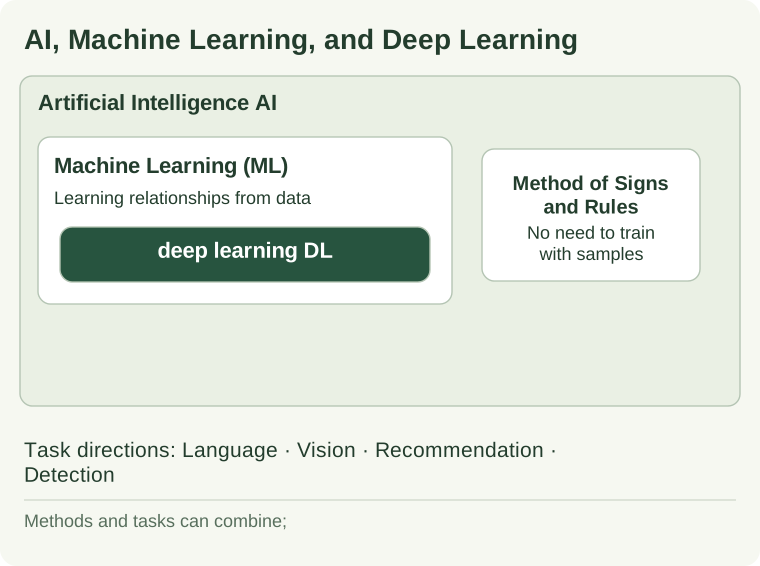
View textual explanation of the diagram
AI is a broader field; machine learning fits models from data, while deep learning uses multi-layer neural networks. Symbolic and rule-based methods do not necessarily belong to machine learning. Tasks such as language, vision, and recommendation can adopt or combine different approaches.
3. AI in Daily Life
AI has been integrated into many common products and services.
Applications | What AI is doing behind the scenes |
|---|---|
Recommendation systems | Analyzing your behavior patterns and comparing them with other users' patterns to recommend content or products; for example, Netflix, Amazon, Spotify |
Voice assistants | Combining speech recognition, natural language processing, and language generation; for example, Siri, Alexa, Google Assistant |
Navigation apps | Predicting traffic by combining real-time and historical data; for example, Google Maps, Waze |
Input prediction | Learning your vocabulary and writing habits under personalized mechanisms and recommending words during input |
Applications across different industries
Healthcare : Assisting in disease diagnosis from medical images, remote patient monitoring, drug discovery, and providing personalized treatment recommendations.
Finance : fraud detection, algorithmic trading, credit risk assessment, personalized financial advice.
retail : inventory management, demand forecasting, personalized marketing, visual search.
manufacturing : quality control, predictive maintenance, supply chain optimization, robot guidance.
customer service : handling common inquiries with chatbots, analyzing sentiment in customer feedback, routing calls and determining priority, predicting customer behavior.
How AI improves user experience
Personalization makes content and experiences more aligned with individual preferences; automation handles repetitive tasks, freeing up time for creative work; enhanced search understands intent rather than merely matching keywords; voice interfaces, image description, and real-time translation improve accessibility.
Note: These are application domains, not indicative of reliable performance across all scenarios. Applications in healthcare, lending, and other areas affecting personal rights require separate validation, human oversight, and applicable conditions.
4. Finding Opportunities to Apply AI at Work
Distinguishing real capabilities from marketing claims
When discussing learning-based AI, observe whether it learns from data, handles change and edge cases, and processes complex unstructured data such as text and images. Do not judge solely based on whether a product claims to be 'intelligent'.
Applications | according to the learning-based AI evaluation criteria on this page | reason |
|---|---|---|
traditional calculator | no | executes fixed mathematical rules without a learning process |
Netflix recommendations | yes | analyzes viewing data to generate personalized recommendations |
chatbot following pre-defined branches | cannot be considered to have learning capability | may simply navigate based on pre-written responses |
neural machine translation | yes | learns mapping relationships from large-scale language examples |
Note: A manually written dialogue tree is different from a 'decision tree model trained through training.' This discussion refers to the former, and thus cannot conclude that decision tree algorithms do not belong to machine learning.
Identifying opportunities from four types of tasks
- repetitive and pattern-identification tasks : document classification, quality inspection, data entry and verification, trend analysis in reports.
- prediction-dependent activities : demand forecasting, maintenance scheduling, risk assessment, resource allocation.
- Tasks involving unstructured data : email classification, customer feedback analysis, image and video processing, meeting transcription.
- Tasks requiring large-scale personalization : customer communication, product recommendations, learning and development, content distribution.
Before deciding whether to pursue, ask four key questions
Is the data sufficient? The original text uses hundreds or thousands of examples to illustrate the data needed for learning. The actual required amount depends on the task, data quality, model, and whether a pre-trained model is used; this quantity should not be treated as a one-size-fits-all threshold.
Is the potential return worth the investment? Prioritize valuable problems: even small improvements can yield significant benefits.
Do we have the required capabilities and resources? Consider internal capabilities, no-code platforms, or collaboration with external teams.
Is AI suitable for this problem? Sometimes, simple automation based on clear rules is more efficient.
Knowledge Summary
This page explains the difference between machine learning and traditional programming using the 'learning from data' paradigm, introducing machine learning, neural networks, natural language processing, and computer vision, and connecting them to everyday product and industry tasks. Teachable Machine With the rise of no-code tools, people without programming backgrounds can now try building simple models. When identifying opportunities, start with pattern recognition, prediction, unstructured data, and personalization, while also evaluating data availability, investment, and simpler alternatives.
Video Script One: What is Artificial Intelligence
What exactly is artificial intelligence? How does it differ from traditional computing? Starting from these fundamental questions, we introduce concepts that will be referenced repeatedly later. As AI increasingly enters business, education, and daily life, it's essential to understand what it can and cannot do, especially that certain capabilities cannot be assumed merely from the name.
When we talk about AI, we refer to computer systems capable of performing tasks typically associated with human thinking, such as pattern recognition, language understanding, or learning from experience.
A simple analogy can help: imagine teaching a child to recognize cats. You wouldn't hand them a checklist first, but instead show them photos and say, 'This is a cat.' After seeing enough examples, they can identify a cat they've never seen before. Machine learning works similarly: processing data and identifying patterns from it.
First, let's clarify a few key terms. Data is the raw information used by AI to learn, which can be images, text, numbers, or any other form of digital information suitable for learning. Algorithm is the method by which these systems process data and solve problems. Here, they are not simple 'if-then' rules, but rather a set of operations designed to detect patterns and make predictions.
After feeding data to a machine learning algorithm, the algorithm learns from it. The result of this learning is a trained model . It represents the system's learned knowledge in mathematical form, analogous to an internal representation.
The process of using an algorithm to process data and build a model is called training . During training, the system adjusts its parameters to perform the task more effectively. After training, the model can infer, predict, or judge new data by applying the patterns it has learned to new situations.
What's the difference from traditional computing? In traditional computing, humans write explicit instructions: 'If a certain condition occurs, perform this action.' For example, if the email subject contains 'urgent,' mark the email as high priority. Computers strictly follow these rules, but the process itself doesn't enable them to learn new judgment methods.
Modern machine learning takes a different path. Instead of writing all rules upfront, humans provide the system with many examples, such as thousands of emails already labeled as 'urgent' or 'not urgent.' The system analyzes these examples, identifies patterns, and forms its own judgment rules. After training, it can apply these rules to new emails it has never seen before.
This difference is crucial. Traditional computing takes input, executes pre-written rules, and produces output; machine learning learns patterns from input and example outputs, then applies those patterns to new inputs. In other words, the system discovers patterns from examples.
The power of this approach lies in its ability to detect complex patterns that are difficult or impossible to program explicitly, and to adapt to new situations. In summary, this explanation focuses on systems that learn from data, build models from examples, and then use those models to predict or make decisions. Next, we'll look at the main types of these systems and how they're applied across different industries.
Note: This is an analogy of the learning process and does not imply that the model possesses human-level understanding; the earlier explanation regarding the scope of learning AI also applies.
Video Script Two: Main Technical Types
Having understood the basic meaning of AI and its differences from traditional computing, let's now examine the main technologies driving modern applications.
First, look at Machine Learning : a method that allows the system to improve its performance through data, rather than relying solely on explicitly written programs. For instance, when predicting house prices, the system doesn't directly apply a fixed formula written by a human, but instead analyzes thousands of historical transaction records to learn the relationship between property features and prices.
Here, we introduce two approaches. The first is Supervised Learning : using labeled data, i.e., examples with correct answers. For spam filtering, you can provide emails already marked as spam or normal. The model learns the patterns that distinguish between the two types and then classifies new emails. This is similar to learning with human feedback on answers.
The second is Unsupervised Learning : unlabeled data, where the system discovers hidden patterns on its own. For customer segmentation, it might identify distinct groups (such as those who prefer discounts versus those who prefer premium products) without being explicitly told about these categories. This is somewhat like exploring a new city without a guide.
Next, look at Neural Networks : a type of model inspired by the human brain, composed of interconnected, layered nodes, each referred to as a 'neuron.' Each node receives information, processes it, and passes the result to the next layer. The connections between nodes have weights that determine the strength of influence. During training, these weights are adjusted, allowing the model to gradually learn patterns.
Its basic structure includes an input layer that receives raw data, hidden layers that process information, and an output layer that generates predictions.
Natural Language Processing Enables computers to process and generate human language. Voice assistants like Siri and Alexa first convert speech into text, then interpret intent and organize responses. Email categorization, sentiment analysis of product reviews, and language translation all fall under this category of applications.
Finally, look at Computer Vision : a technology that enables machines to process and interpret visual information. The system can detect objects, people, and actions in images or videos. For instance, when a smartphone camera focuses on a human face, or when a photo service suggests tags for a person, computer vision may be involved. The system analyzes visual content using patterns, shapes, colors, and edges.
Applications include facial recognition, autonomous driving, medical image analysis, and quality control in manufacturing.
Each technology excels at different types of problems. Traditional machine learning methods are often used for structured data, while neural networks are more effective for complex tasks involving language and images. Machine learning, neural networks, natural language processing, and computer vision collectively support a wide range of real-world applications. Next, we'll explore how these technologies appear in everyday products and across various industries.
Note: These categories are not mutually exclusive. Neural networks belong to machine learning methods, while natural language processing and computer vision are application and research domains that often also use neural networks.
Video Script Three: AI in Daily Life and Industries
We've already introduced AI and its key technologies. Now let's see how they appear in the daily products and services we use, and how they influence different industries.
AI often runs in the background, so users may not notice it. Features like Netflix's content recommendations, Amazon's product suggestions, and Spotify's playlists all use recommendation systems. For example, in video recommendations, the system can analyze what a user has watched, when, whether they've already viewed it, and where they paused, then recommend content likely to keep them engaged.
Siri, Alexa, and other voice assistants combine speech recognition, natural language processing, and language generation. When you ask about the weather, the system must recognize words amid accents and background noise, understand that you're inquiring about local weather conditions, and then present the information in a natural way.
Navigation apps like Google Maps analyze real-time user data, historical patterns, and events that might affect traffic to predict road conditions and suggest routes. The input prediction feature on mobile keyboards may also adapt gradually to your writing habits, improving recommendations.
Now let's look at specific industries. Healthcare AI in the medical field can analyze medical images to assist in disease diagnosis, and is also used for remote monitoring, drug discovery, and personalized treatment recommendations. The text report describes diagnostic performance in a way comparable to that of professional radiologists.
Finance In the financial sector, fraud detection systems can flag suspicious transactions in real time; algorithmic trading makes rapid decisions based on market conditions; and loan evaluation systems may leverage broader datasets to assess creditworthiness.
retail Businesses use AI to predict demand, optimize inventory, and deliver personalized marketing campaigns tailored to individual customer preferences.
manufacturing In manufacturing, quality inspection systems can rapidly detect defects, while predictive maintenance analyzes equipment data to identify early warning signs before failures occur.
customer service In customer service, chatbots can handle common inquiries around the clock, and sentiment analysis tools monitor social media and customer feedback to detect shifts in satisfaction levels.
Beyond specific industries, AI also improves experiences in several key areas. Personalization Making content more aligned with individual preferences; Automation Handling repetitive tasks, freeing up time for creative work; Enhanced search Try to understand intent, not just match keywords; Accessibility support Leverage voice interfaces, image descriptions, and translation to enable broader access to technology.
AI has become an integral part of many digital experiences and business processes, often working behind the scenes to enhance products and services. Later, you can explore creating models using user-friendly tools.
Note: The statement regarding diagnostic accuracy does not include specific studies, disease types, data sets, or comparison conditions, so it cannot be interpreted as all medical AI achieving professional-level performance. Descriptions of specific product behaviors are illustrative examples and do not replace the actual features or privacy statements of the product at the time.
Video Script Four: Identifying Genuine Opportunities
In the following exercise, distinguish between AI capabilities and marketing language, and identify potential applications relevant to your work. After AI becomes a popular term, some products (even those with only basic automation) may claim to use AI. Assessing actual capabilities helps understand the potential value it can add.
In this presentation focused on learning-based AI, there are three key perspectives. First, it learns from data rather than merely following rules: the system analyzes data and can improve through additional examples and training. Second, can it handle change, edge cases, and imperfect inputs? Traditional systems may fail when conditions change. Third, can it process complex unstructured data such as text, images, and audio?
Use a few examples to test your understanding. A traditional calculator follows fixed rules and has no learning process. Netflix recommendations analyze viewing data to generate personalized suggestions. A customer service chatbot's capabilities depend on its implementation: if it simply follows a pre-defined dialogue tree, it cannot be considered learning-capable simply because it can 'chat.' Google Translate's neural machine translation learns language correspondences from large volumes of linguistic material.
In your own work, identify four types of tasks. First is repeated pattern recognition : If a process involves consistently sorting, classifying, or identifying patterns, there may be room for automation. For example, a model could help review contracts and identify specified clauses.
Second is predictive tasks involving many variables : If forecasting the future based on historical data, machine learning can incorporate more variables than typical human analysis, aiming to improve prediction accuracy.
Third is unstructured data processing : If you're still manually handling files, emails, voice recordings, or images, consider exploring relevant methods. For example, use NLP to classify support tickets based on content.
Fourth is large-scale personalization : If you currently provide the same content to everyone but want to tailor it to individuals, AI may make that approach more feasible. For example, a marketing team could adapt content to interests and behavior.
When evaluating, continue asking three practical questions. Do we have enough data? This text mentions 'hundreds of thousands of examples' to describe certain learning requirements. Is the potential return on investment worth the investment? Prioritize high-value issues that can deliver clear business improvements. Do we have the necessary capabilities and resources? We can build internal capabilities, use no-code platforms, or seek external partnerships.
Remember that AI is not always the right solution. Sometimes, simpler approaches like basic automation are sufficient and more efficient.
By now, you have a basic understanding of what AI is, its key technologies, application methods, and how to identify work opportunities. Further reading in the following sections can help you understand how each technology and model works in detail.
Translator's note: The 'hundreds of thousands of examples' mentioned here does not align with the 'hundreds or thousands' in the main text; both have been preserved and noted. There is no single data volume that applies to all AI projects; the required amount can vary significantly depending on whether pre-trained, fine-tuned, or from-scratch models are used.
Related Reading
If you'd like to further distinguish between 'content analysis' and 'content generation', continue reading Getting Started with Generative AI ; then apply these capabilities to work by starting with Opportunity Identification Exercise .
Reference and Extended Reading
The following are editorial additions for queries and learning entry points, which you can refer to as needed.
- Google: What is machine learning? (Chinese): Differentiate between supervised learning, unsupervised learning, reinforcement learning, and classification versus regression.
- Google: Neural Networks (Chinese): Continue understanding the relationship between input, hidden layers, and output.
- Google Teachable Machine (Interactive tool / English): Experience training and classification using image, sound, or pose examples.